
What Is Custom Ecommerce Design — and Why It Matters
Custom ecommerce design is the process of building an online store from the ground up — tailored to your brand, your customers, and your specific business goals — rather than squeezing your business into a pre-built template.
Here’s a quick breakdown of what that means in practice:
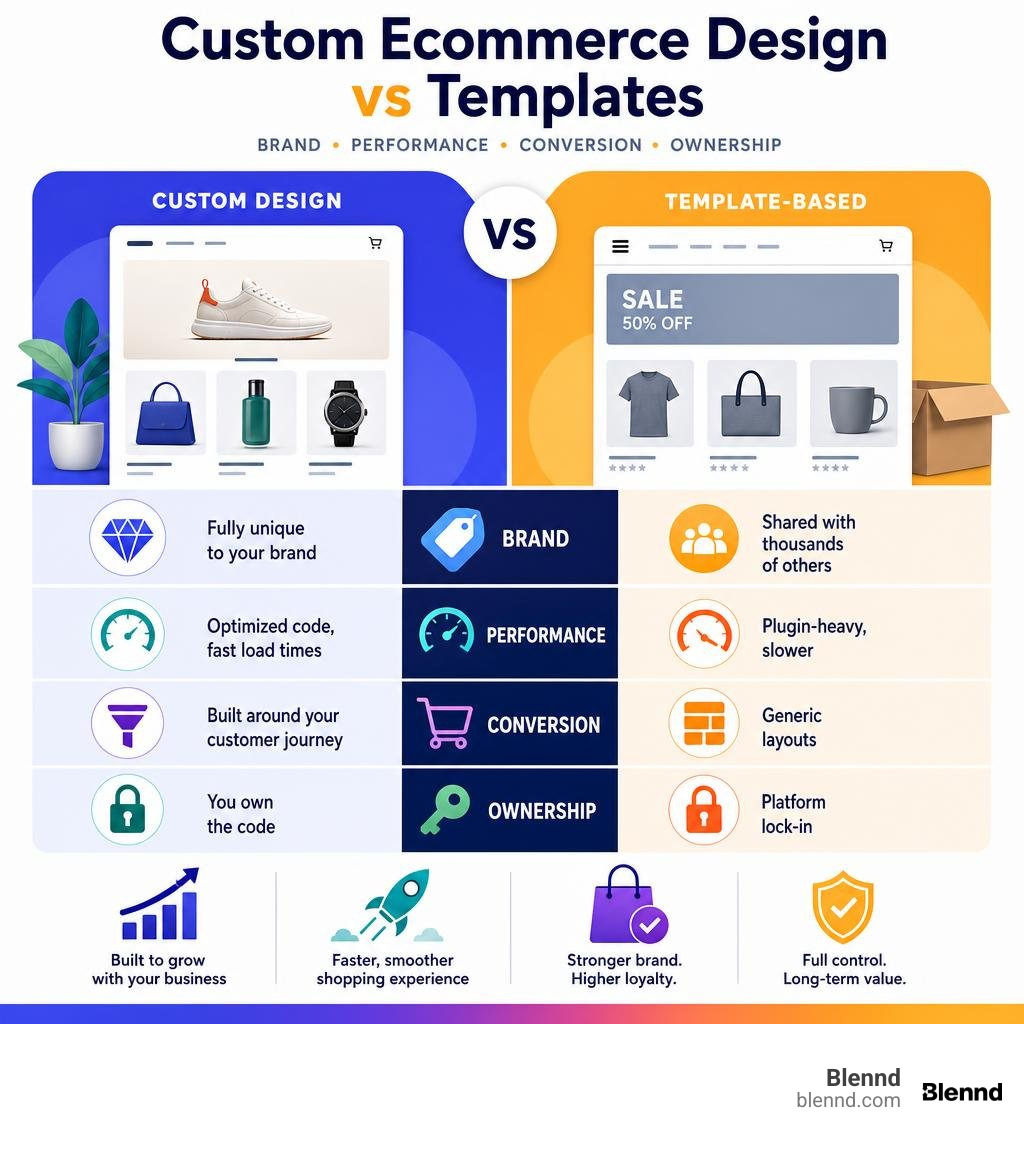
| Custom Ecommerce Design | Template-Based Store | |
|---|---|---|
| Brand identity | Fully unique to your business | Shared with thousands of others |
| Conversion optimization | Built around your customer journey | Generic layouts |
| Performance | Optimized code, fast load times | Plugin-heavy, slower |
| Scalability | Grows with your business | Limited by platform constraints |
| Ownership | You own the code | Platform lock-in |
| Cost structure | One-time build investment | Ongoing fees + transaction cuts |
The stakes are real. Businesses that add an online store see an average 38% increase in revenue. But that growth depends on a store that actually converts — and over 60% of purchases now happen on mobile. A generic template rarely delivers on either front.
Template-based shops all look the same. They limit what you can build, how fast your site loads, and how well it reflects your brand. For growth-focused brands, that’s not a trade-off worth making.
I’m Chris Kuhn, co-founder of Blennd — and with nearly two decades leading teams at large agencies, I’ve seen how custom ecommerce design separates high-performing stores from ones that simply exist online. In the sections ahead, I’ll walk you through everything you need to know to make a smart, strategic decision for your business.
Why Custom Ecommerce Design Outperforms Templates
When launching or scaling an online storefront, the temptation to take a shortcut with a pre-made template is understandable. Templates promise a quick start and low upfront costs. However, relying on a cookie-cutter layout is a lot like setting up a luxury boutique inside a generic cardboard box. It might hold your products, but it won’t craft an unforgettable experience that inspires long-term loyalty.
For brands aiming to establish true market authority, investing in a Services/Custom Web Design Agency or a dedicated Services/Web Design Agency is a strategic necessity. A custom build offers unrestricted design freedom, clean performance architecture, and complete control over your customer journey. This approach is particularly critical for high-ticket markets where consumer expectations are exceptionally high, as detailed in our guide on High-End Web Design for Luxury Websites.
Elevating Brand Identity and Customer Trust
Your website is often the very first touchpoint a customer has with your brand. If your storefront looks identical to hundreds of other drop-shipping sites, savvy consumers will notice. This lack of visual distinction directly chips away at customer trust.
With custom ecommerce design, we build a cohesive digital environment from scratch. Every pixel, micro-interaction, transition, and hover state is designed to reflect your specific corporate identity. Rather than trying to force your brand guidelines into a rigid template grid, our Brand Design System Consultants help you construct a comprehensive visual framework that communicates quality and security.
When your site features custom-tailored layouts and bespoke interactive elements, customers intuitively perceive your business as more credible, secure, and professional.
Overcoming Template Limitations and Platform Lock-in
Template-based software-as-a-service (SaaS) systems often lock you into rigid ecosystems. While they make simple things easy, they make complex, custom features incredibly difficult—or outright impossible—to implement.
As your business grows, you will inevitably hit the ceiling of what standard templates can handle. You may find yourself forced to pay high monthly subscription fees for third-party plug-ins just to handle basic operations, or handing over an escalating percentage of your revenue in platform transaction cuts.
Furthermore, relying on a stack of unoptimized plug-ins degrades your page speed and introduces security vulnerabilities. By choosing a custom architecture, such as those discussed in Custom Shop Design | MyShopSys, you gain complete code ownership. This prevents platform lock-in, eliminates unnecessary plug-in dependencies, and ensures your site can scale smoothly alongside your business.
Designing for Conversions and Mobile-First Experiences
With over 60% of purchases happening on mobile, designing a desktop site and simply “shrinking” it to fit a smartphone screen is no longer a viable strategy. Modern ecommerce demands a mobile-first design philosophy. Every button, menu, and checkout field must be meticulously optimized for tap targets, thumb reach, and rapid load times.
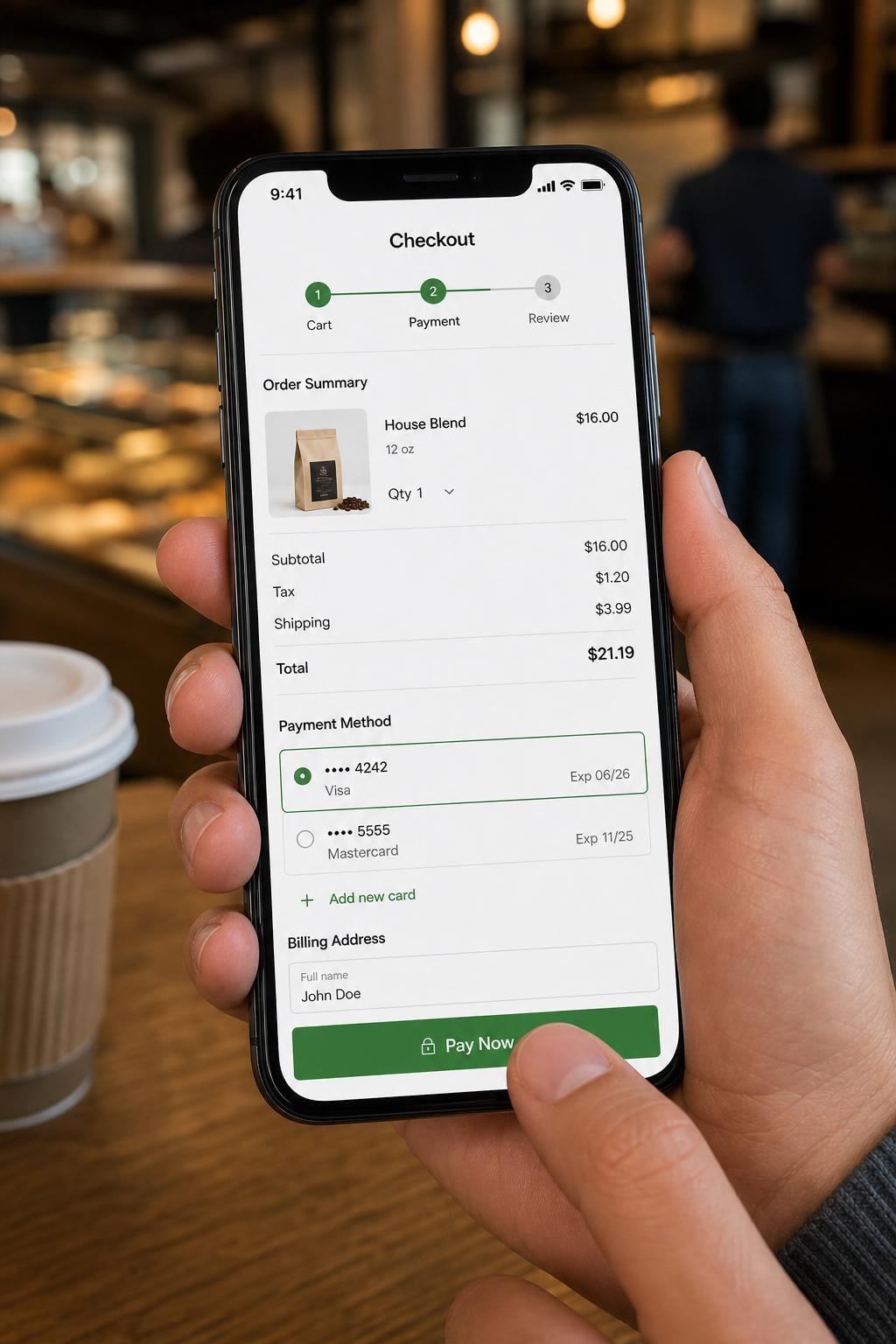
When we approach conversion rate optimization (CRO), we treat design as a science. Every visual decision we make is backed by behavioral data, which we outline in our framework for Website Conversion Rate Optimization Design Decisions.
Maximizing ROI with Custom Ecommerce Design and CRO
A beautiful website is useless if it doesn’t guide users toward making a purchase. Custom design allows us to build frictionless paths to purchase, directly translating to higher conversion rates and maximized return on investment (ROI).
Rather than settling for a standard, multi-step checkout sequence that causes cart abandonment, we design streamlined, single-page checkouts tailored to your specific audience. We also run extensive user testing to analyze exactly where users get stuck.
By leveraging insights from our Ux User Testing Strategies and incorporating Conversion Rate Optimization Drive More Revenue, we eliminate friction. For brands utilizing major platforms, we also implement the Best CRO Platforms For Shopify Ecommerce Websites to run continuous A/B tests and fine-tune every element of the shopping experience.
Performance Optimization and WCAG Accessibility
Page speed is a critical ranking factor for search engines and a direct driver of online sales. A one-second delay in page load time can lead to a significant drop in conversions. Template-based sites are notoriously bloated with unused CSS, heavy JavaScript libraries, and redundant code.
In contrast, our custom developments utilize modern, high-performance frameworks like Next.js to deliver lightning-fast load times. We also build accessibility directly into the foundation of our sites, ensuring compliance with Web Content Accessibility Guidelines (WCAG).
By utilizing our comprehensive Usability Testing Services, we ensure that your digital storefront is fully accessible to users of all abilities, expanding your market reach and protecting your brand from legal compliance issues.
Advanced Functionality and Omnichannel Integration
Modern retail is no longer confined to a single channel. To succeed in today’s market, businesses must bridge the gap between their brick-and-mortar locations, online storefronts, social media platforms, and back-end inventory systems.
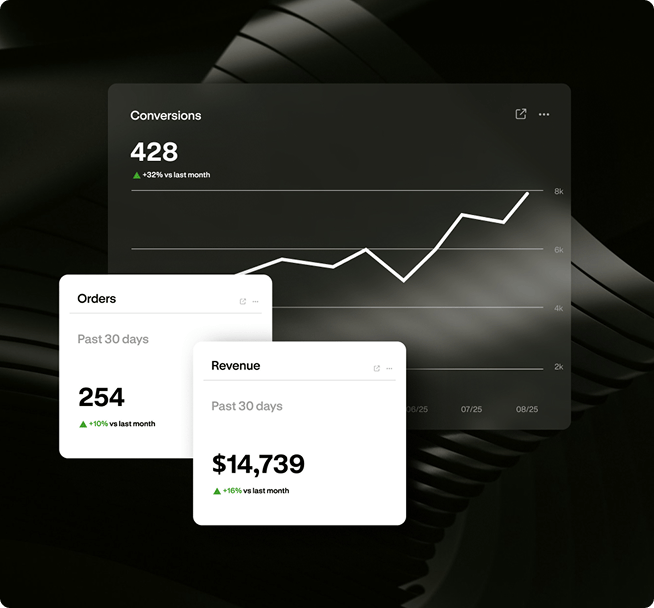
Achieving this level of cohesion requires a robust, custom-built digital core. Our work across diverse industries/ecommerce demonstrates that seamless system integration is what separates scaling enterprises from stagnant storefronts.
Integrating In-Person and Online Sales
For businesses running physical stores alongside their digital presence, real-time synchronization is vital. A custom storefront integrates directly with your physical Point of Sale (POS) systems, establishing a centralized customer directory and unified multi-location inventory management.
This deep integration prevents overselling by updating stock levels instantly across all channels the moment a purchase is made in-store or online. It also enables modern omnichannel fulfillment options, such as:
- Buy Online, Pick Up In-Store (BOPIS)
- Curbside pickup
- Local delivery routes
- Real-time carrier shipping calculations
By implementing Services/Custom Website Development, we build these complex workflows directly into your platform, creating a unified experience for both your customers and your inventory management team.
Marketing, SEO, and Social Media Integrations
A custom ecommerce storefront should act as the central hub for all your marketing efforts. Rather than relying on rigid, basic SEO fields provided by standard templates, custom builds allow for advanced schema markup, clean URL structures, and dynamic XML sitemaps that search engines love.
We also build direct integrations with social commerce tools (such as Instagram and Facebook Shops), email marketing automation engines, and advanced analytics tracking. By using a Data Driven Website Development approach, we ensure that every user action—from product views to abandoned carts—is tracked accurately. This clean data pipeline fuels high-performing marketing campaigns and personalized promotion engines that keep your customers coming back.
The Strategic Roadmap to a Custom Storefront
Successfully launching a custom ecommerce platform requires a structured, strategic roadmap. It’s not just about writing code; it’s about aligning your business operations, content strategy, and technical architecture before a single line of design is finalized.
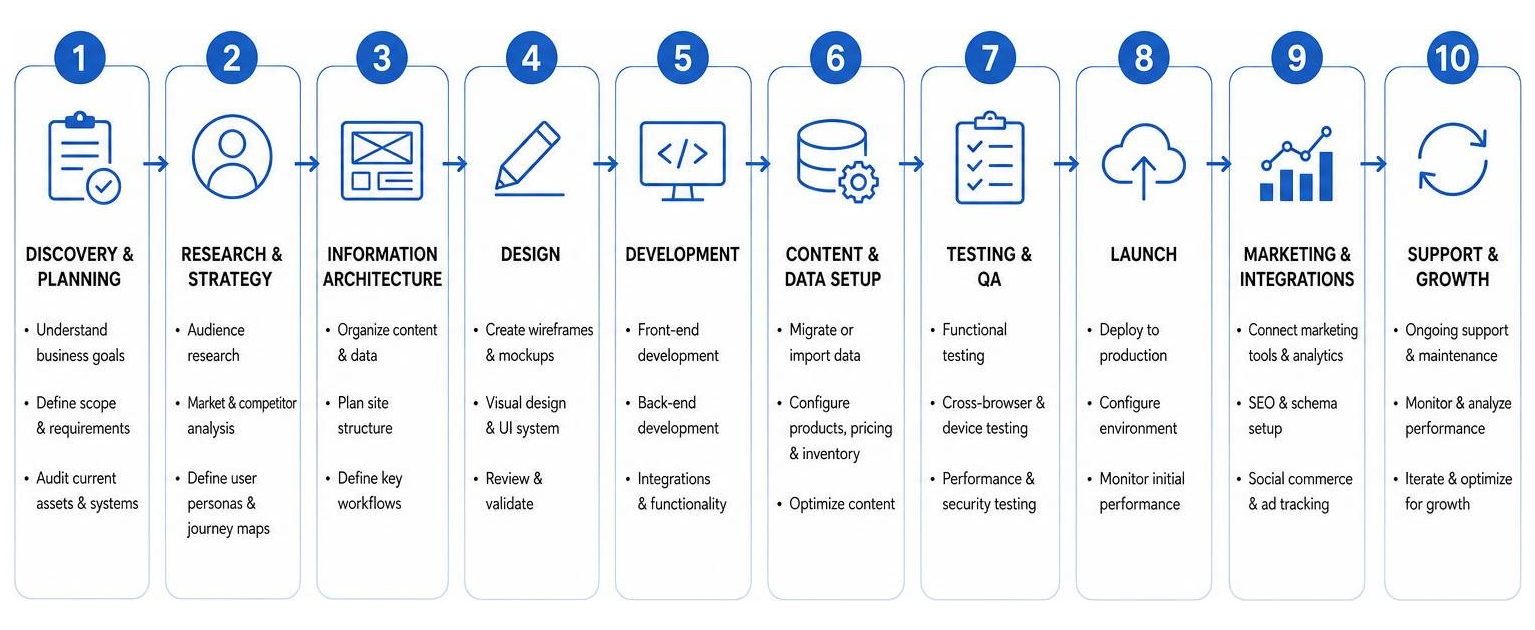
To set your project up for success, we recommend starting with our comprehensive Website Planning Guide and using our ecommerce website revamp checklist to audit your current assets.
Key Steps in the Custom Ecommerce Design Process
Our custom design and development workflow is structured to minimize risk and maximize performance:
- Discovery & Strategy: We dive deep into your business goals, target audience, and operational requirements.
- Information Architecture & Wireframing: We map out the user journey and site structure, establishing navigation and page layouts before introducing visual design.
- Interactive Figma Prototyping: We build highly detailed, interactive prototypes in Figma. This is a crucial step because making changes during the design phase costs only hours, whereas making changes during the development phase can take weeks of coding.
- Custom Next.js Development: Our engineering team builds a fast, secure, and scalable storefront using clean, custom-coded components.
- Quality Assurance & Usability Testing: We rigorously test the site across multiple devices, screen sizes, and browsers to ensure flawless performance.
- Data Migration & Launch: We safely migrate your existing customer records, order histories, and product databases to the new system, followed by a coordinated launch.
To ensure your design remains engaging and modern throughout this process, we weave in the latest Web Design Trends and adhere to strict Ux Design Website Development principles.
Balancing Customization with Ease of Use and Maintenance
One common concern businesses have about custom websites is that they will be too difficult to manage without a developer on standby. We solve this by building intuitive, block-based Content Management Systems (CMS) tailored to your team’s workflow.
Your marketing team will be able to easily update copy, swap out banners, launch promotions, and add new products without touching a line of code. We also establish Enterprise Website Design Systems so that any new pages or components your team creates in the future automatically match your established brand guidelines, maintaining design integrity over time.
To ensure your team is fully equipped from day one, we also recommend reviewing our Website Content Strategy and our Guide To Writing Copy For Websites to streamline the content creation process.
Cost, Timeline, and ROI Considerations
While template sites offer low initial costs, they often carry hidden long-term expenses in the form of high transaction fees, platform subscription tiers, plug-in licenses, and lost revenue from poor mobile conversion rates.
A custom storefront requires a larger upfront investment but delivers a significantly higher ROI over time. Adding a high-performing website can yield an average 38% increase in revenue.
When budgeting for your project, consider these primary cost and timeline factors:
- Scope complexity: The number of unique page layouts, product variations, and third-party integrations.
- Data migration: The volume and complexity of existing customer, order, and product data that needs to be securely transferred.
- Custom functionality: Advanced features like subscription portals, custom product builders, or multi-warehouse inventory systems.
To help you plan your budget, you can explore our transparent pricing page. If you are preparing to reach out to agencies, we highly recommend downloading our Web Design RFP Toolkit and reading our guide on How To Write Web Design RFP to ensure you receive accurate, comparable proposals.
Our team has delivered high-impact custom platforms for a wide range of brands, from complex B2B portals to high-end retail platforms. You can check out some of our real-world success stories, including our work with Work/Gift Card Giant, work/corjl, work/gotu, and work/inflow.
Frequently Asked Questions about Custom Ecommerce Design
How long does a custom ecommerce design project take?
A typical custom ecommerce design and development project takes anywhere from 12 to 24 weeks. This timeline depends on the complexity of the site, the volume of data migration, and the number of integrations required. The process is divided into distinct phases—starting with discovery and wireframing, moving to interactive prototyping, and ending with custom development and rigorous testing to ensure a flawless launch.
Can I manage and update a custom ecommerce site myself after launch?
Absolutely. We design and build custom websites with user-friendly administrative dashboards. We integrate headless or hybrid CMS platforms that allow your team to easily manage inventory, update product listings, run promotional campaigns, and edit content blocks without needing any technical or coding knowledge.
How does custom design improve my site’s SEO compared to templates?
Custom design allows us to write clean, lightweight, and semantic code from scratch, which drastically improves page load times—a major search engine ranking factor. Additionally, custom sites are built with tailored technical SEO foundations, including custom-configured schema markup, optimized site architectures, and clean URL structures, giving your business a distinct advantage in organic search rankings over template-bloated competitors.
Conclusion
In the competitive digital landscape of July 2026, a generic online storefront is no longer enough to capture and retain customer attention. To stand out, build trust, and maximize your revenue, your business needs a digital storefront that is as unique as your brand.
At Blennd, we create custom, performance-focused websites and integrated growth-marketing systems that turn traffic into measurable revenue growth. By uniting strategy-first custom development with continuous optimization, we help B2B and B2C brands scale without limits.
Ready to elevate your online store? Explore Blennd’s Custom Web Design Services today and let’s build something extraordinary together.