
Your website now has two distinct audiences reading the same pages, and they evaluate content in fundamentally different ways. The first is a human buyer who opens three tabs, skims for signals of competence, and closes two within fifteen seconds. The second is an AI retrieval system scanning for structured claims it can cite in an answer. Both audiences punish the same content failures: hedged positioning, repetitive explanations, and generic assertions that could describe any company in your category.
Table of Contents
- Key Takeaways
- What Is a Website Content Strategy?
- The Dual-Audience Problem in Website Content Strategy
- The Core Components of a Website Content Strategy
- Types of Website Content (and What Each One Is For)
- How to Build a Website Content Strategy in 7 Steps
- What Makes Content Citable (And Scannable)
- Common Website Content Strategy Mistakes (and How to Avoid Them)
- Concise Top-Level Messaging with Depth on Demand
- Ownable Language as Differentiation
- Website Content Strategy Best Practices: The Shift to Editorial Clarity
- Frequently Asked Questions
- Sources
Key Takeaways
The strongest website content strategy in 2026 serves both audiences with the same structural discipline. Concise top-level messaging that states a clear position. Depth available on demand through progressive disclosure. Specific claims backed by evidence rather than marketing platitudes. Editorial clarity over card-based layout sameness. The shift matters because generative AI has flooded the web with undifferentiated copy, which makes distinctive voice and specific positioning competitive advantages rather than stylistic preferences. Sites that hedge their claims to avoid sounding too narrow now sound like every AI-generated competitor, which means they get skipped by buyers and ignored by citation engines.

Case Study
A scalable content system for Western Colorado University.
What Is a Website Content Strategy?
A website content strategy is the plan that governs what your site says, who it says it to, how that content is structured, and how you will know whether it worked. It covers five things: positioning and messaging hierarchy, information architecture, the content types you publish and the job each one does, governance and ownership, and the measurement that tells you whether any of it is working.
It is not a content calendar. A calendar schedules production. A strategy decides what deserves to exist in the first place, and what should be cut.
Most website content strategies fail in the same place. They answer “what should we publish?” before they answer “what do we actually claim, and why would anyone believe us?” That order is backwards, and it is the reason so many companies end up with more content and less clarity.
The Dual-Audience Problem in Website Content Strategy
Most B2B websites were designed under the assumption that more explanation equals more credibility. Service pages run 1,200 words when 400 would work. About pages hedge every claim with qualifiers. Homepages present six value propositions because leadership couldn’t agree on one. The result is a site where a skimming buyer can’t figure out what you do differently, and an AI system can’t extract a citable claim because every sentence contains three caveats.
This wasn’t always costly. When search rewarded keyword density and backlinks, verbose pages performed fine. Human buyers tolerated dense copy because competitors’ sites were equally cluttered. Two things changed.
First, generative AI made it trivially easy to produce 800-word service pages, which means the web is now saturated with generic B2B copy that says nothing specific. The penalty for sounding like everyone else used to be obscurity. Now it is invisibility, because if a language model cannot tell your positioning apart from ten competitors, it has no reason to name you.
Second, a real (if still small) share of discovery moved into AI assistants. It is worth being precise about the size of this, because the marketing industry is not. Across published 2026 studies, AI referrals account for roughly 1% of total website traffic, with a range of about 0.1% to 2.8% depending on industry. IT and technology sit at the top of that range at around 2.8%; utilities and communications sit near the bottom. Anyone telling you that a quarter of your traffic already comes from ChatGPT is selling something.
The reason it matters anyway is direction and quality. AI referral volume has grown several hundred percent year over year, and multiple independent datasets find AI-referred sessions converting at higher rates than Google organic. Similarweb measures AI referral conversion around 7.1%, against a Google organic baseline closer to 2.8%. Adobe’s retail data found AI-referred sessions with materially lower bounce rates and higher engagement. The channel is small, high-intent, and compounding, which is exactly the profile of a channel you want a baseline on before it gets big, not after.
That is the honest case for citability. Not “AI is 25% of your traffic.” It is: the people arriving this way are further along and more likely to buy, the volume is growing fast, and the structural work that makes you citable is the same work that makes you clearer to humans. You are not choosing between the two audiences. You are serving one discipline that happens to satisfy both.
The Core Components of a Website Content Strategy
Positioning and messaging hierarchy. What you claim, in what order, on every page. This is the layer most companies skip and the one that determines whether anything else works. If you cannot state your differentiation in one sentence a competitor could not also say, you do not have a messaging hierarchy; you have a word cloud.
Information architecture. How content is organized so buyers can self-navigate to what they need. Most sites are organized around the internal org chart (Products, Services, About). Buyers are not organized that way. They arrive with a question and a stage of evaluation.
Content types and their jobs. Every page should have one job. A case study proves. A service page qualifies. A pricing page filters. A guide earns trust and search visibility. When pages take on multiple jobs, they do all of them badly.
Governance and ownership. Who can publish, who approves claims, who is responsible for accuracy, and how often content gets reviewed. Without this, sites accumulate stale claims and contradictory numbers, which is a credibility problem long before it is an SEO problem.
Measurement. Which pages produce pipeline, which produce traffic and nothing else, and which are dead weight. If you cannot answer that, you cannot decide what to cut, and cutting is most of the work.
Types of Website Content (and What Each One Is For)
Positioning content (homepage, about page). Job: state who you are, who you serve, and why you are different. This should be the shortest and most argued-over content on the site.
Service and product content. Job: qualify. A good service page tells the wrong buyer to leave as clearly as it tells the right buyer to convert.
Proof content (case studies, testimonials, data). Job: make claims believable. Specific numbers beat adjectives. “467% increase in form submissions” carries weight that “transformative results” does not.
Educational content (guides, articles, playbooks). Job: earn discovery and trust before the buyer is ready to talk. This is also the content most likely to be cited by AI answer engines, because it is where you make extractable claims.
Conversion content (pricing, contact, demo request). Job: reduce friction at the decision point. Ambiguity here is expensive: a buyer who cannot find out roughly what you cost will often just leave.
How to Build a Website Content Strategy in 7 Steps
- Audit what you have. Pull every URL, its traffic, its conversions, and its rankings. Sort into three buckets: producing pipeline, producing traffic only, producing nothing. You cannot decide what to write until you know what to delete.
- Define your position. Write the one sentence a competitor could not truthfully say about themselves. If you cannot write it, that is the project, not the content calendar.
- Map buyer questions to evaluation stages. List the actual questions buyers ask at each stage: early (what is this, do I need it), middle (who does it well, how do approaches differ), late (what does it cost, why you, what could go wrong). Every question is a page or a section.
- Build the messaging hierarchy. Decide what claim leads on every page type, what supports it, and what gets cut. Then hold the line. The instinct to add one more value proposition is the instinct that produced the site you are trying to fix.
- Match content types to the architecture. Assign every planned page one job. If a page has two jobs, split it. If two pages have the same job, merge them.
- Write for extraction. State the answer first, then support it. Use descriptive headings that match real questions. Put the specific claim in the first 100 words. This is what makes a page scannable for a human and citable by an AI engine, and it is the same work.
- Instrument and measure. Track conversions by page, not just traffic. Separate AI referral traffic into its own channel in analytics so you have a baseline before that channel matters. Then review quarterly and cut what is not working.
What Makes Content Citable (And Scannable)
AI answer engines do not cite pages because they contain a target keyword six times. They cite pages that make a clear, specific claim the model can paraphrase and attribute. In practice, the content that gets extracted tends to share four structural features: a direct answer near the top of the page, supporting evidence immediately after the claim, minimal hedging language, and concrete nouns instead of abstract buzzwords.
Human buyers scan for the same signals. Nielsen Norman Group’s research on how users read on the web found that users do not read linearly; they scan headings, links, and the first words of paragraphs, looking for the signal that tells them whether to keep going. Dense paragraphs get skipped. Sections that open with generic setup language (“In today’s competitive landscape…”) train users to skip the next three sentences, because they have learned nothing specific is coming.
When Blennd rebuilt the website for 7Factor Software, a consulting firm positioning around engineering quality over fast delivery, the original site buried that differentiation under paragraphs of capability descriptions. Visitors arriving from paid search or a referral could not immediately tell how 7Factor differed from an offshore dev shop. The rebuild led with the core claim (they are slower and more expensive because they prioritize long-term maintainability over short-term feature velocity), used case studies as proof rather than adjectives, and cut generic capability copy substantially. Form submissions increased 467%.
The same clarity that helped human buyers understand the value proposition made the site extractable. An AI system could state 7Factor’s differentiation in one sentence because the site stated it in one sentence, then supported it with evidence instead of repeating it three different ways.
We have seen the pattern show up in AI visibility measurement directly. On our work with Active Release Techniques, restructuring content around clear, specific claims produced 25% growth in organic keywords, 57 new keywords in the top 3-10 positions, and a 28-point increase in AI visibility score over the engagement. Same content discipline, two different retrieval systems, one result.
Common Website Content Strategy Mistakes (and How to Avoid Them)
Most B2B website content suffers from two related problems: hedging and genericness. Hedging is when you add qualifiers to every claim to avoid sounding too specific. “We help companies improve efficiency” becomes “We partner with organizations to drive meaningful improvements in operational effectiveness where appropriate.” Genericness is when your positioning could apply to any competitor. “We’re a customer-focused, innovative, results-driven agency” describes 10,000 agencies.
Both problems stem from the same fear: that stating a clear position will exclude potential buyers. So marketing teams write copy that tries to appeal to everyone, which means it resonates with no one. A homepage that lists eight value propositions communicates that the company has not decided what it is actually good at. A service page that describes capabilities without explaining when you would choose this vendor over another wastes the reader’s time and yours.
Google’s guidance on creating helpful content is explicit that content which mainly summarizes what others have said without adding value, or which is written to match a search string rather than to help a person, is not what the systems are built to reward. Hedged, generic content is the purest form of that failure: it is written to avoid being wrong rather than to be useful.
AI systems handle genericness even more harshly than search does. If your service page says “We provide comprehensive solutions tailored to your unique needs,” a language model has nothing to work with, because the sentence contains no falsifiable claim. Compare that to “We rebuild Shopify stores that are failing Core Web Vitals using a phased approach that does not disrupt active transactions.” The second sentence gives the model something concrete to attribute, which makes it far more likely to appear in an AI-generated answer.
Concise Top-Level Messaging with Depth on Demand
The strongest website content strategy follows a two-layer structure. The top layer is concise, specific, and immediately scannable. It answers the core question (what do you do, how are you different, who is this for) in 40 to 60 words. The second layer provides supporting detail, evidence, case examples, and edge-case explanations for readers who need them. But that depth is available on demand, not forced into the opening paragraphs.
This mirrors how editorial publications structure articles. The lede tells you what the story is about and why it matters. The next passage explains the stakes. Then the piece delivers the detail. Readers who only have 30 seconds get the core argument. Readers who have five minutes get the full analysis. Everyone gets what they came for.
Most B2B websites do the opposite. They open with setup and context, then bury the value proposition four paragraphs down. By the time the page explains what makes the company different, most visitors have already left. AI systems exhibit a similar pattern: they extract disproportionately from the top of the page, because that is where signal-to-noise ratio is highest.
Progressive disclosure solves both problems. State your positioning in the first 100 words. Use the next 200 words to explain why it matters and for whom. Then expand into case examples, objection handling, and technical detail for buyers who are further along in evaluation. Structure the page so a skimmer can get your core message from headings and opening sentences, while a deep reader can access full context without friction.
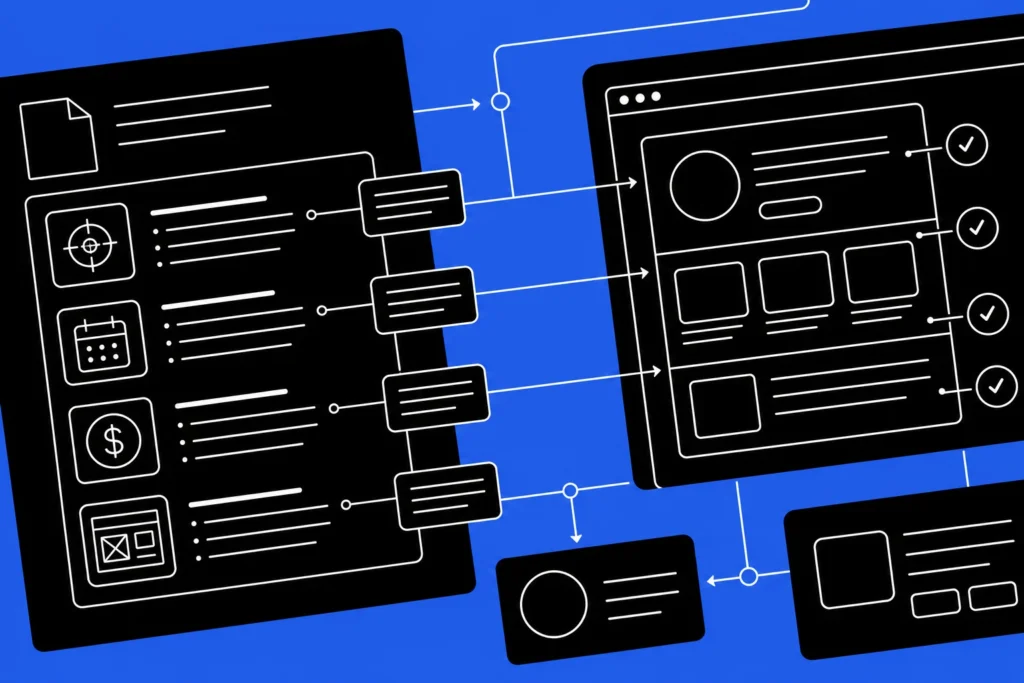
Western Colorado University is the clearest version of this we have worked on. Their site had grown past 3,000 pages, serving prospective students, parents, alumni, faculty, donors, and internal staff, each arriving with different questions and no obvious path to an answer. The fix was not more content. We built five personas, 15 user flow diagrams, and a full information architecture, then rebuilt the site around those journeys and launched with just over 2,000 pages. Fewer pages, each with a clearer job. Application completions rose 40%, bounce rate dropped 38% within 90 days, and overall users increased 61%.
Our web design and development services apply this structure across service pages, case studies, and resource content, and our SEO and answer engine optimization work treats extractability as a ranking input rather than a separate initiative. The goal is not to write less; it is to organize so the most important claims come first and the supporting architecture is accessible but not intrusive.
Ownable Language as Differentiation
One of the clearest signals of AI-generated content is language that could have been written by any company in a category. “We leverage cutting-edge technology to deliver innovative solutions” is a sentence no human would write if they were trying to communicate something real. It is also a sentence that appears in some form on thousands of B2B websites, because generative models trained on existing web content reproduce the most common patterns.
This creates an opportunity. If your competitors’ websites all sound like they were generated, a site with a specific voice and concrete claims will stand out to both human readers and AI citation systems. Ownable language does not mean clever taglines or forced brand personality. It means stating your positioning in terms specific enough that a competitor could not swap their company name into the sentence without it sounding false.
“We rebuild websites for companies that have outgrown their Wix site but are not ready for a full enterprise CMS” is ownable. “We create beautiful, user-friendly websites that drive results” is not. The first sentence tells a reader exactly who the service is for and positions against two named alternatives. The second is interchangeable with 10,000 web design agencies.
Ownable language also makes content more citable, because specificity gives AI systems something concrete to extract. A model summarizing “web design agencies” cannot meaningfully differentiate between 50 generic positioning statements, so it falls back on directory rankings, review counts, and third-party lists. A model answering “website platforms for growing companies” can cite your specific claim about the Wix-to-custom transition, because you are the only result that articulated that positioning clearly.
The shift requires discipline. It means choosing a lane, naming your differentiation explicitly, and accepting that some buyers will not resonate with it. But the alternative (trying to appeal to everyone with language so broad it means nothing) is worse, because now those buyers cannot tell you apart from AI-generated sameness. It is why we maintain distinct practices with distinct positions, like fitness and gym marketing and functional medicine marketing, rather than one page that claims we serve everyone equally well.
Website Content Strategy Best Practices: The Shift to Editorial Clarity
The strongest B2B sites now look less like traditional corporate websites and more like editorial publications. Tighter word counts. Stronger headlines. Clearer section breaks. More white space. Less reliance on card-based layouts where every module looks identical and content gets crammed into 40-character constraints because the design system demands it.
This is not a design trend; it is a structural response to the dual-audience problem. Editorial clarity works because it serves both the skimmer and the deep reader. A well-structured page with descriptive headings and concise opening sentences gives a time-constrained buyer everything they need in 60 seconds. It also gives an AI system clean, extractable claims it can cite with confidence.
Card-based layouts do the opposite. They force writers to compress ideas into bite-sized chunks that often lack enough context to be useful on their own. Three-column grids with 40-word blurbs create visual consistency but obscure differentiation, because every module has the same structure and word count whether the content deserves it or not. The result is a homepage that looks organized but communicates nothing specific.
The shift toward editorial clarity also solves an internal problem: it forces content strategy decisions. If you only have 60 words for your homepage positioning statement, you cannot hedge. You have to pick a lane. That discomfort is the point. The best websites do not try to communicate everything; they communicate one core idea clearly, then provide paths for different audiences to go deeper in the directions that matter to them.
A conversion-focused custom web design process should start with messaging architecture before layout design, so the site structure supports the core argument instead of fighting it. The pattern works because clarity and citability are the same problem: both require stating your position in terms specific enough to be differentiated and concrete enough to be actionable.
Frequently Asked Questions
Does shorter content hurt SEO rankings?
No. Google’s systems reward content that fully answers the user’s query, but “fully” does not mean “verbosely.” A 600-word page that directly addresses search intent outperforms a 2,000-word page that repeats the same points three ways. AI answer engines follow the same pattern: they extract the clearest answer, not the longest page in the results.
How do I know if my website content is too dense?
Run a simple test: ask someone outside your company to visit your homepage and explain what you do in one sentence after 30 seconds. If they cannot, your positioning is buried. Then check your analytics for average engagement time and scroll depth on key pages. If visitors spend under 45 seconds on a 1,200-word service page, they are not reading; they are scanning for signals and not finding them.
How much of my traffic actually comes from AI search right now?
Less than most vendors imply. Across published 2026 studies, AI referrals account for roughly 1% of total website traffic on average, with a range of about 0.1% to 2.8% depending on industry (IT and technology sit at the top of that range). The reason it still matters is direction and quality, not volume: AI referral traffic has grown several hundred percent year over year, and multiple datasets show AI-referred sessions converting at higher rates than Google organic. Treat citability as a leading indicator, and instrument AI referrals as their own channel in GA4 so you have a baseline before the channel gets big.
Can I use the same website content strategy for different service lines?
Only if those service lines share a core positioning. The mistake most B2B brands make is creating separate pages for each offering without a unifying thesis. Better approach: lead with your differentiated positioning, then show how it applies across different contexts, using case studies and industry-specific examples to demonstrate the same methodology in different markets.
What if my product actually is complex and needs detailed explanation?
Complexity is an argument for better structure, not more words. State the core concept in 40 words. Use the next 100 words to explain why it matters and who it is for. Then expand into technical detail, implementation steps, and edge cases for readers who need them. Progressive disclosure serves both the executive who wants a quick overview and the technical evaluator who needs spec-level depth.
How often should I audit my website content strategy for clarity?
At minimum annually, but ideally whenever engagement metrics decline or after a positioning shift. If bounce rate is climbing on key landing pages, or if average engagement time is dropping while traffic holds steady, clarity is likely the issue. AI citation patterns are another signal: if competitors are being named in AI answers for your category and you are not, your content may not be structured clearly enough to extract.
Sources
- 2026 AEO / GEO Benchmarks Report. Conductor, 2026. (13,770 enterprise domains, 3.3 billion sessions, May–September 2025.)
- How Users Read on the Web. Nielsen Norman Group.
- Creating Helpful, Reliable, People-First Content. Google Search Central.
Ready to audit your website content strategy for clarity?
Most B2B sites carry more copy than they need, and the bloat shows up in bounce rates, engagement metrics, and citation rates in AI search. Blennd’s content audits identify what to cut, what to elevate, and how to structure messaging so both buyers and AI systems can extract your core value. If your traffic is growing but conversions aren’t, the problem is often clarity, not volume.