
That is the real job of modern web design and digital marketing in this category. As wellness spending grows, consumer expectations rise, and AI-driven search changes discovery, brands need more than disconnected tactics. They need a digital growth system that connects positioning, content, search visibility, user experience, proof, and conversion. McKinsey’s research on the global wellness market and Google’s guidance on helpful, reliable, people-first content point in the same direction: audiences want useful, credible, specific information, not polished noise.
Key Takeaways
- Health and wellness brands compete on trust, clarity, and proof as much as they compete on aesthetics.
- A strong website is not a brochure. It is the operating center for search visibility, education, conversion, and retention.
- AI search environments reward content that is structured, useful, specific, and easy to extract.
- Paid media performs better when it sends visitors into focused journeys instead of generic pages.
- The strongest brands align web design, SEO, content, local visibility, and CRO into one measurable system.
- Blennd case studies like Transform Fitness, Orangetheory Fitness, and GoTu show what that looks like in practice.
Why health and wellness brands need a different digital strategy
Health and wellness decisions are personal. Whether someone is choosing a therapist, a med spa, a fitness studio, a longevity service, or a specialty provider, they are not just comparing features. They are evaluating credibility, safety, fit, outcomes, and ease.
That raises the bar for digital performance. NIQ’s Global State of Health & Wellness 2025 says consumers are looking for trust, clarity, and solutions, while also emphasizing transparency and access to expert-backed information. McKinsey found that 82% of US consumers consider wellness a top or important priority in their everyday lives. Those two signals matter together. When interest is high and scrutiny is high, vague messaging and weak user journeys become expensive.
This is why health and wellness marketing cannot be treated like generic lifestyle marketing. Your website has to reassure. Your content has to clarify. Your proof has to feel real. Your calls to action have to match the visitor’s level of readiness.
The biggest reason health and wellness brands underperform online
Most underperformance comes from fragmentation. The website team works on design. The marketing team works on campaigns. SEO is handled separately. Analytics live in another corner. The result is a brand that looks polished but still leaks opportunity at every stage.
That shows up in familiar ways:
- Paid traffic goes to pages that do not convert
- Organic traffic lands on thin, generic service pages
- The homepage tries to speak to everyone at once
- Booking flows introduce friction right when intent is highest
- Proof is buried, vague, or disconnected from what the buyer actually cares about
When this happens, brands often diagnose the wrong problem. They assume they need more traffic, more content, or more ad spend. In reality, they usually need a clearer system.
A better model starts with this idea: your website is not separate from your marketing. It is the hub your marketing feeds. That is why a health and wellness website and digital marketing strategy should reinforce each other instead of operating as separate investments.
What a modern health and wellness growth system includes
A real growth system is built around how people evaluate and act, not around internal service silos.
1. Positioning that reduces uncertainty
Health and wellness brands often rely on broad promises like “feel your best” or “take control of your health.” Those lines are not wrong, but they are not enough. They do not explain why this brand, for this audience, for this outcome.
Strong positioning answers four questions quickly:
- What do you do?
- Who is it for?
- Why should someone trust you?
- What should they do next?
This is especially important in a category where science-backed decision-making is becoming more important. McKinsey notes that consumers are increasingly asking, “What does the science say?” That means websites and campaigns need more specificity, not just better visuals.
2. Website architecture built around real journeys
Health and wellness brands rarely have one audience and one intent. They often serve first-time researchers, comparison shoppers, ready-to-book visitors, returning members, and referral traffic from local search or paid media.
The site structure should reflect that. Instead of forcing everyone through the same generic path, high-performing brands build clear routes for services or treatment categories, location-based intent, condition or goal-based intent, membership or class exploration, and brand validation and proof.
Google’s guidance on AI features and your website and structured data in Search reinforces the same principle from a technical angle: content should be organized, understandable, and easy for systems to interpret. Good architecture improves human usability and machine extractability at the same time.
3. Trust-building design
Design matters in health and wellness because people judge legitimacy fast. But trust-building design is not mostly about looking premium. It is about reducing hesitation.
That means showing the right proof at the right moment:
- Credentials, expertise, or methodology
- Testimonials that speak to outcomes and experience
- Clear process explanations
- Transparent pricing or next-step expectations where appropriate
- Real imagery and believable language
- Clean layouts that do not make important decisions feel harder than they should
Google’s SEO Starter Guide notes that descriptive structure and link text help users and search engines understand what pages are about. In practice, that same clarity also supports trust. A confusing site rarely feels credible, no matter how attractive it looks.
4. Search visibility across traditional SEO and AI discovery
Search is no longer just about ranking a few landing pages. People now discover brands through classic search results, AI Overviews, AI Mode, local packs, YouTube, review ecosystems, and cited summaries in generative interfaces.
That does not mean brands need AI SEO hacks. It means they need pages and content that are clearly structured, topically aligned, specific enough to quote, genuinely useful, and supported by sound technical foundations.
Google’s people-first content guidance and its documentation on AI search features are explicit about the direction of travel. Helpful content created for people remains the goal, and inclusion in AI experiences depends on the same core quality signals, not tricks. AI visibility strategy should be approached as an extension of solid SEO and content architecture, not as a separate gimmick.
What Blennd case studies show in the real world
The theory gets more useful when it is grounded in execution.

Transform Fitness: the website has to support the sale, not just the brand
Transform Fitness shows why fitness and wellness brands need booking-centered UX, not just aspirational branding. Blennd’s work included scheduling and booking integrations, membership purchase functionality, SEO-optimized architecture, and a more premium, high-end experience that still kept usability front and center. The outcome was stronger engagement, easier booking, and a site better suited for business expansion.
This matters because many studios still treat the website like a digital brochure while the real transaction happens elsewhere. That creates unnecessary friction. If the class, consultation, or membership flow is a core revenue action, it has to be part of the design strategy from the beginning.

Orangetheory Fitness: local growth depends on connected journeys
Orangetheory is a strong example of how local expansion works when digital marketing and website strategy are tightly linked. Blennd built hyper-local paid search and paid social campaigns that directed fitness prospects to the right location-focused experiences, with messaging built to drive free workout sign-ups and founding memberships.
The lesson is broader than fitness. For any multi-location health or wellness brand, local demand generation performs better when ads, landing pages, proof, and conversion paths all reflect the local decision context.
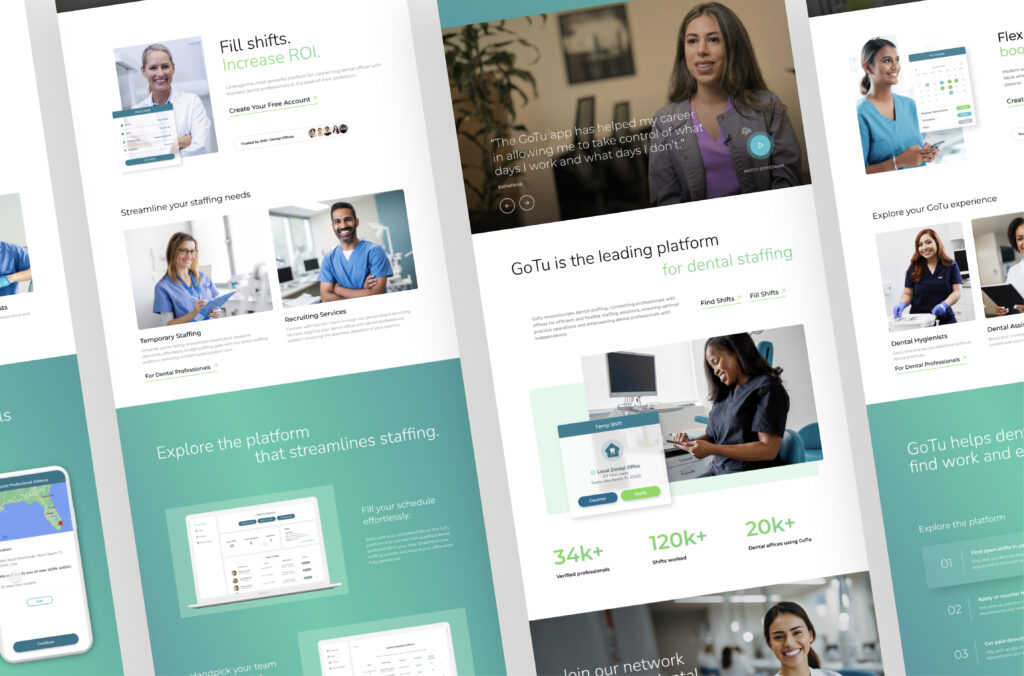
GoTu: scalable architecture matters when multiple audiences are involved
GoTu is healthcare-adjacent rather than pure wellness, but it is still highly relevant. The brand needed a scalable, conversion-optimized digital experience for a marketplace serving both dental professionals and practices, with national growth ambitions and more than $20M ARR. That kind of challenge requires clear audience segmentation, strong information architecture, and content pathways that do not collapse under complexity.
Health and wellness brands that serve multiple personas can learn from that model. If your site speaks to too many audiences in the same voice and structure, it usually ends up persuading none of them especially well.
How AI changes web design and digital marketing for wellness brands
AI changes both discovery and expectations.
First, search experiences increasingly summarize and compare information before the click. Google says AI Overviews are designed to provide a snapshot with links to explore the web further, and its site-owner guidance frames AI inclusion as an extension of strong, useful content rather than a separate optimization trick. That raises the value of pages that are easy to quote, easy to interpret, and built around real questions.
Second, AI makes generic content easier to produce, which means generic content becomes less valuable. If ten wellness brands publish the same broad article on gut health, longevity, recovery, or member benefits, none of them gain much strategic advantage. The differentiator becomes specificity, perspective, proof, and structure.
Third, AI increases the importance of brand clarity. Salesforce’s State of Marketing report says 83% of marketers recognize the shift toward personalized, two-way messaging, while only one in four are satisfied with how they use data to power those moments. For health and wellness brands, that gap often shows up as generic nurture flows, broad landing pages, and messaging that fails to adapt to where the visitor is in the journey.
The takeaway is simple. AI does not remove the need for better websites and smarter marketing. It raises the standard for both.
What serious health and wellness brands should do next
A strong next step is not “publish more content.” It is to tighten the system.
Start here:
Audit your messaging
Can a first-time visitor understand your offer, audience, differentiation, and next step within seconds?
Audit your service and location pages
Do your most important pages answer real decision questions, show proof, and support action?
Audit your booking or lead flow
Is the conversion path easy, credible, and matched to visitor intent?
Audit your content architecture
Are you building content around real topics, services, use cases, and search behavior, or just filling a blog calendar?
Audit your proof system
Are testimonials, outcomes, credentials, and methodology visible where decisions happen?
Audit your technical foundations
Are your pages structured clearly enough for search engines and AI systems to understand them?
If the answer to several of these is no, the issue is probably not effort. It is orchestration.
FAQ: Web design and digital marketing for health and wellness brands
What makes web design for health and wellness brands different?
The category carries more trust sensitivity than standard consumer marketing. Visitors often need reassurance, clarity, proof, and low-friction next steps before they are willing to book, buy, or inquire.
Is SEO still worth investing in for wellness brands in the AI era?
Yes. Strong SEO now supports both traditional organic discovery and visibility in AI-assisted search environments. The priority is not keyword stuffing. It is building clear, useful, technically sound content and page structures that can be understood and cited.
Should health and wellness brands prioritize web design or digital marketing first?
Neither works as well in isolation. If your site does not convert, more traffic will leak. If your marketing is weak, even a strong site will underperform. The better approach is to prioritize the parts of the system that most directly limit growth right now.
What should a wellness website be optimized for?
At minimum: trust, clarity, mobile usability, search visibility, conversion paths, proof placement, speed, and content structure. For many brands, local discovery and booking flow optimization also matter.
How can health and wellness brands prepare for AI search?
Create pages that are specific, well-structured, credible, and easy to extract. Publish useful content tied to real services and questions. Strengthen internal linking. Support the site with sound technical SEO and structured data where relevant.
The brands that grow will be the ones that make trust operational
This category is only getting more competitive. Consumers are spending more, researching more, and expecting more. McKinsey’s wellness research points to continuing growth across areas like women’s health, healthy aging, and in-person fitness, while NIQ highlights the growing importance of transparency, trust, and information quality. Brands that still treat their website as a static asset and their marketing as a series of disconnected tactics will keep leaving growth on the table.
The brands that pull ahead will be the ones that make trust operational. They will build websites that answer questions clearly, content that earns visibility, journeys that reduce friction, and marketing systems that connect awareness to action. That is the new playbook.
Need help building a stronger health and wellness growth system?
Blennd helps health and wellness brands turn their website into a real growth engine through strategy, UX, SEO, AI visibility, and conversion-focused digital marketing. If your current site looks good but is not doing enough to support trust, discovery, and performance, it may be time to rethink the system rather than just the surface. Contact us to start a conversation.
Sources:
- McKinsey & Company
The trends defining the $1.8 trillion global wellness market in 2024
2024
https://www.mckinsey.com/industries/consumer-packaged-goods/our-insights/the-trends-defining-the-1-point-8-trillion-dollar-global-wellness-market-in-2024 - Google Search Central
Creating helpful, reliable, people-first content
2026
https://developers.google.com/search/docs/fundamentals/creating-helpful-content - Google Search Central
SEO Starter Guide
2026
https://developers.google.com/search/docs/fundamentals/seo-starter-guide - Google Search Central
AI features and your website
2026
https://developers.google.com/search/docs/appearance/ai-features - Google Search Central
Introduction to structured data markup in Google Search
2026
https://developers.google.com/search/docs/appearance/structured-data/intro-structured-data - Google Search
AI Overviews
2026
https://search.google/ways-to-search/ai-overviews/ - NielsenIQ
Global State of Health & Wellness 2025
2025
https://nielseniq.com/global/en/insights/report/2025/global-state-of-health-wellness-2025/ - Salesforce
State of Marketing Report: Tenth Edition
2025
https://www.salesforce.com/marketing/resources/state-of-marketing-report/ - Blennd
Transform Fitness Website Design Case Study
https://blennd.com/work/transform-fitness-website-design/ - Blennd
Orangetheory Fitness Case Study
https://blennd.com/work/orangetheory-fitness/ - Blennd
GoTu Case Study
https://blennd.com/work/gotu-dentist-website-design/