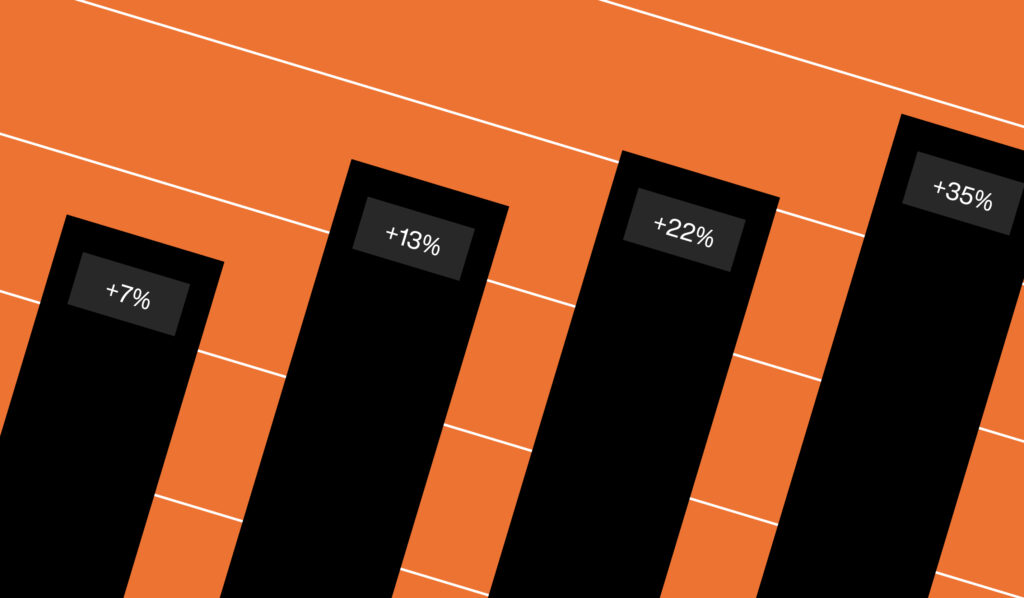

Adobe’s Q2 2026 Digital Insights report landed with a data point that should reorder every acquisition roadmap: AI-referred traffic to U.S. retailers converted 42% better than traditional organic search traffic. Twelve months earlier, AI chatbot traffic lagged organic by double digits. This is not incremental improvement. This is an inflection point.
For the last two years, most marketing teams treated AI chatbot traffic the way they treated voice search in 2017: interesting, worth monitoring, probably overhyped. Adobe’s data suggests that era just ended. AI-referred visitors are not tire kickers. They are higher-intent, further along the decision journey, and more likely to convert than users arriving from a traditional Google SERP.
This article explains what changed, why AI-referred traffic converts at higher rates, and how brands can optimize for retrieval and citation in ChatGPT, Perplexity, and Claude.
Key Takeaways
- AI-referred traffic to U.S. retailers now converts 42% better than organic search, per Adobe Q2 2026 data, a complete reversal from 12 months prior
- AI chatbot users exhibit higher intent because the conversational interface pre-qualifies fit before surfacing a brand
- Optimizing for AI citations requires entity recognition, structured data that aids parsing (not performative schema markup), and community proof from Reddit and forums
- Traditional SEO levers like backlinks and domain authority matter less in AI retrieval; firsthand proof and parseable content architecture matter more
- Brands that treat AI citations as an experimental channel rather than a priority acquisition lever will lose share to competitors who optimize early
Why AI-referred traffic converts better than organic search
The 42% conversion lift is not a fluke. It reflects a structural shift in how users arrive at a brand. In traditional organic search, a user types a query, scans a SERP, clicks a result, and lands on a page. That user may or may not be ready to act. The SERP is a discovery surface, not a qualification surface.
In an AI chatbot interaction, the user describes a problem or need in conversational language. The AI asks clarifying questions or infers intent from context. By the time the AI cites a brand, that brand has already been pre-qualified as a plausible match for the user’s stated criteria. The user is not browsing. The user is evaluating a shortlist.
This mirrors the conversion gap between cold search traffic and warm referral traffic. AI citations function more like referrals than like SERP placements. The user trusts the AI’s curation, the way they would trust a colleague’s recommendation. The brand that gets cited benefits from implied endorsement.
The second dynamic at play is context compression. A user arriving from a SERP often has only a query and a meta description to work with. A user arriving from an AI chatbot has already received a synthesized explanation of why the brand fits their need. The friction between “I found this brand” and “I understand why this brand is relevant to me” has been removed. The user lands on the site with higher clarity and higher intent.
This does not mean AI chatbots are uniformly better for all brands. Brands that rely on high-volume, low-consideration traffic, like content publishers optimized for programmatic ad revenue, may see lower total volume from AI channels even if per-visit conversion rates improve. For brands selling products or services where consideration matters, the 42% lift is structurally durable.
The signals AI engines use to decide what to cite
AI answer engines do not rank content the way Google ranks pages. They retrieve content. The distinction matters. Ranking is comparative: which page is most authoritative for this query relative to all other pages? Retrieval is binary: does this content contain a trustworthy, parseable answer to the user’s question?
OpenAI’s documentation on ChatGPT search retrieval describes a grounding layer that prioritizes three attributes: entity clarity, structural parseability, and corroborative signals from high-trust environments like Reddit and forums. Brands that optimize for these three attributes improve citation probability.
Entity recognition
AI engines retrieve content by matching user queries to entities, not just keywords. An entity is a distinctly identifiable thing: a brand, a product, a person, a place, a concept. Google has used entity-based retrieval since the Knowledge Graph launched in 2012, but AI chatbots take this further. They need to extract not just the entity itself but its relationships and attributes.
If your brand is not recognized as a distinct entity, the AI has no anchor to cite you. Entity recognition depends on consistency. Your brand name, product names, and key concepts must appear in structured, machine-readable formats across your owned properties and in third-party references.
This is where structured data markup matters, but not in the way most SEO practitioners think. AI engines do not care whether you have an Organization schema on your homepage because it satisfies a Google Rich Results checklist. They care whether the schema helps them parse what your brand is, what you do, and how you relate to adjacent entities. Schema-for-schema’s-sake is performative. Schema that clarifies entity relationships aids retrieval.
Practical entity optimization includes marking up product names, service categories, author bylines, and company relationships with schema that maps to real-world meaning. It also includes ensuring that your brand’s NAP (name, address, phone) data is consistent across your site, Google Business Profile, LinkedIn, Crunchbase, and anywhere else your entity appears publicly.
Structural parseability
AI engines retrieve content by scanning HTML structure, not by rendering a visual design. If your content is locked inside JavaScript-rendered React components with no server-side fallback, the AI may not see it. If your most important claim is buried in the seventh paragraph under a vague heading, the AI may skip it.
Content that converts well in AI citation environments is structured like an FAQ or a specification sheet. It answers specific questions in clearly delineated sections. It uses headings that match real queries. It avoids long blocks of undifferentiated prose.
This does not mean dumbing down your content. It means organizing your content so that both humans and machines can extract discrete answers. A 2,500-word thought leadership article can be highly citable if it is broken into logical H2 and H3 sections with descriptive headings. A 500-word homepage with no headings and one long paragraph is not citable, even if a human reader could extract meaning from it.
The best test for parseability is this: if you removed all visual design and collapsed your page into plain HTML with headings and paragraphs, would an unfamiliar reader still understand your core claims and how they relate to each other? If not, an AI engine will struggle too.
Community proof and Reddit signals
Reddit and Google announced a content partnership in 2024 that gave Google deeper access to Reddit’s corpus for training and retrieval. ChatGPT, Perplexity, and Claude all surface Reddit threads in their citation flows. This is not incidental. Reddit functions as a trust filter. When an AI engine sees repeated positive mentions of a brand in Reddit threads, it treats that brand as more citation-worthy.
Community proof is harder to manufacture than backlinks. You cannot buy Reddit upvotes the way you can buy guest posts. The brands that benefit from Reddit signals are the brands that actual users recommend in organic conversation threads. This rewards brands with strong product-market fit and vocal user communities. It penalizes brands that rely on paid amplification without underlying user satisfaction.
For B2B brands, the equivalent signal often comes from Hacker News, niche Slack communities, or industry-specific forums. The key pattern is the same: unpaid, user-generated recommendations in environments where astroturfing is discouraged. AI engines treat these mentions as more trustworthy than brand-authored content because the incentive to deceive is lower.
If your brand does not yet have community proof, you cannot force it. You can, however, make it easier for satisfied users to mention you. This includes ensuring your brand name is spellable and searchable, creating content that users want to link to when answering questions, and participating in community threads in a non-promotional, helpful capacity.
What matters less in AI retrieval than in traditional SEO
Some traditional SEO levers matter less, or differently, in AI citation environments. Understanding what to deprioritize is as important as understanding what to invest in.
Backlinks from authoritative domains still matter for traditional Google rankings, but AI engines do not weight backlinks the same way. A brand with 10,000 backlinks from low-relevance domains will not outrank a brand with 50 citations from Reddit threads and industry forums. Quality of mention beats quantity of links.
Domain authority and domain age also carry less weight. AI engines retrieve based on content quality and entity trust, not on accumulated domain equity. A six-month-old site with strong entity clarity and Reddit mentions can outperform a ten-year-old site with weak content architecture.
Keyword density and exact-match anchor text are irrelevant. AI engines parse semantic meaning, not keyword frequency. Optimizing for “AI chatbot traffic conversion optimization strategies” will not improve retrieval. Writing clear, specific answers to real questions will.
How to restructure your content for AI citation eligibility
Most brands do not need to rebuild their sites from scratch. They need to audit existing content for structural gaps and fill them.
Start with your highest-value pages: product pages, service pages, key landing pages. For each page, ask:
- Is the page organized with descriptive H2 and H3 headings that map to real user questions?
- Does the page include a short, direct answer to the primary query in the first 150 words?
- Are product names, brand names, and key entities marked up with schema that clarifies what they are?
- Is the content readable in plain HTML with CSS disabled?
- Are there any critical claims or details locked in image text, PDFs, or JavaScript-only components?
If the answer to any of those questions is no, the page is under-optimized for AI retrieval.
Next, map your key entities and ensure consistency. Build a simple entity reference table: brand name, product names, service categories, leadership names, key terminology. Ensure those terms appear consistently in schema markup, on-page content, and in third-party listings.
Finally, audit your presence in community environments. Search Reddit, Hacker News, and industry forums for mentions of your brand. If mentions are sparse or negative, focus on earned community trust before optimizing for retrieval. If mentions are positive but shallow, create content that makes it easier for users to explain what you do and why it matters. Infographics, comparison charts, and plain-language explainers are all Reddit-friendly formats that users link to when answering questions.
The risk of waiting
The brands that optimize for AI citation eligibility today are building a structural advantage that compounds. AI engines learn which sources are citation-worthy by observing which sources users trust and engage with after citation. A brand that gets cited early, and drives positive post-click behavior, becomes more citation-worthy over time. A brand that does not appear in the AI’s retrieval set cannot build that trust signal.
This is not a winner-take-all dynamic. Multiple brands can be cited for the same query. But the gap between early movers and late movers widens with every interaction. Brands that treat AI citations as an experimental side channel rather than a priority acquisition lever will lose share to competitors who optimize early.
The 42% conversion lift is not evenly distributed. It accrues to the brands that AI engines cite. If your brand is not in the retrieval set, the lift is zero. If your brand is cited but your content is not structured to convert high-intent traffic, the lift is wasted.
The opportunity is not just to rank in AI answers. The opportunity is to become the brand that AI engines cite when users describe a problem you solve. That requires investing in entity clarity, content structure, and community trust before those signals become saturated.
What we see with our own clients
Adobe’s data covers U.S. retail. Blennd’s clients are B2B and professional-services brands, so we watch how AI-referred visitors behave in our own client analytics. The behavioral half of Adobe’s pattern is what we can see so far: visitors referred by AI assistants appear to arrive more informed. They land already knowing what a company does, skip the awareness content, and move toward service and contact pages sooner than a typical organic visitor.
That matches the pre-qualification mechanism behind Adobe’s findings. When someone asks ChatGPT or Perplexity for a Denver SEO agency that also does web design and clicks through to a cited brand, the fit conversation already happened inside the chat. The click behaves more like a referral than a search impression.
The honest caveats: attribution is messy, because AI assistants can strip referrer data, so part of this traffic hides inside direct. And AI-referred volume is still small; we haven’t verified the conversion numbers ourselves and won’t publish our own data unless a sample can stand on its own. Until then, Adobe’s data is the benchmark, and the buyer behavior we see day to day is consistent with the mechanism behind it.
Frequently Asked Questions
Does this strategy work for B2B brands without a Reddit presence?
Yes. Reddit is one trust signal, not the only one. B2B brands benefit from citations in Hacker News, industry Slack communities, niche forums, and LinkedIn long-form posts. The pattern is the same: unpaid, user-generated recommendations in environments where self-promotion is discouraged. Focus on wherever your buyers congregate and ask questions.
How long does it take to see results from AI citation optimization?
Entity recognition and schema updates can improve retrieval within weeks if your brand is already mentioned in third-party environments. Building community proof takes longer, typically three to six months of sustained engagement. Monitor citation volume in ChatGPT, Perplexity, and Claude by searching for queries your brand should answer and tracking whether you appear in results.
Can I optimize for AI citations without restructuring my entire site?
Yes. Start with your ten highest-value pages. Audit headings, add schema, ensure direct answers appear early, and confirm parseability. AI engines retrieve at the page level, not the domain level. A well-optimized product page can earn citations even if the rest of your site is under-optimized.
What if my brand name is generic or hard to disambiguate?
Disambiguation is critical. Use schema markup to clarify what makes your entity distinct: location, category, parent organization, key products. If your brand name overlaps with a common term, add modifiers in schema and NAP data. AI engines prioritize entities with clear, consistent identity markers.
Do I need to hire an agency to do this?
Not necessarily. Small brands with technical literacy can implement entity schema and restructure headings in-house. Larger brands with complex taxonomies, multi-location footprints, or CMS constraints benefit from specialized support. The hard part is not the markup itself; the hard part is mapping your entities, auditing content structure, and ensuring consistency across properties.
Will traditional SEO stop mattering if AI citations take over?
No. Traditional organic search will remain a primary acquisition channel for years. AI citations are additive, not a replacement. Brands need to optimize for both retrieval paradigms. The overlap is larger than the difference: clear content structure, entity clarity, and user trust benefit both traditional SEO and AI citation eligibility.
Sources
- Adobe Digital Insights Q2 2026 Retail Report. Adobe, 2026.
- Understanding entity-based search and Knowledge Graph. Google Search Central, 2024.
- How ChatGPT search retrieves and cites web sources. OpenAI, 2025.
- The grounding layer: how Perplexity evaluates citation-worthiness. Perplexity, 2025.
- Reddit-Google partnership and search visibility. Reddit, 2024.
- Constitutional AI and source attribution in Claude. Anthropic, 2025.
Need help optimizing for AI citation eligibility?
Most brands know they need to show up in AI answer environments, but few have audited their content structure, entity clarity, or community proof for citation-worthiness. Blennd works with B2B and DTC brands to build the content architecture and entity frameworks that improve retrieval in ChatGPT, Perplexity, and Claude. If you are ready to treat AI citations as a priority acquisition channel, not a science experiment, book a strategy call.