When a competitor’s website consistently generates more qualified leads, the instinct is to blame their design. Design is rarely the real reason. More often, their site is doing a few specific things yours isn’t, and most of them are fixable without a redesign.
Key Takeaways
The sites that win more leads tend to share the same handful of advantages:
- They make the customer feel understood in the first few seconds. Most sites lead with what the company is proud of. The winners lead with the customer’s problem, so a visitor thinks “this is for me” before they have decided to pay attention. That early recognition is what earns the scroll, and most lost leads are lost before the scroll.
- They put proof where doubt happens, not on a separate page. Customer get skeptical at predictable moments, reading a claim, weighing a price, comparing options. Strong sites answer that doubt in the same breath with a relevant case study or a named result. Weaker sites keep the proof filed away under “Case Studies,” where the skeptical buyer never goes.
- They speak to a specific customer instead of everyone. A page built for “healthcare marketing” beats a generic services page for the healthcare customer every time, because relevance reads as competence. When a competitor has a page for your buyer’s exact situation and you have one page for all situations, they feel like the specialist and you feel like the safe backup.
- They ask for the right amount of commitment at the right time. The fastest way to lose an early-stage visitor is to offer them only “Request a Demo.” Sites that convert well meet researchers with something low-stakes and save the big ask for people who are ready. Matching the offer to the moment is often worth more than any design change.
- They respect that the customer is on a phone. A large share of B2B research now happens on mobile, between meetings, before anyone fills out a form. If the desktop site is polished and the mobile experience is an afterthought, the competitor who treated mobile as the main event has already made a better first impression.
- They show up where customers now look for answers. Customers increasingly ask Google’s AI and ChatGPT for recommendations before they visit any site. A competitor who gets named in those answers is shaping the shortlist while you are still waiting to be found. Visibility has quietly moved upstream of your homepage.
These gaps compound. A site that trails on three or four at once will lose pipeline even if its traffic holds steady, because each gap quietly removes customers at a different stage. The sections below break down how to spot each gap on your own site versus a competitor’s, and the scorecard that follows turns this into a side-by-side comparison you can act on.
The 10 Fixes, in Order of Impact
If you want the whole playbook at a glance, here are the ten fixes that close the gaps above, sequenced so the highest-impact work comes first:
- Lead with the customer’s problem, not your company. Rewrite your homepage hero around who you serve, the problem you solve, and the outcome you deliver, so a first-time visitor knows the site is for them within seconds. Fix positioning before you touch anything visual.
- Move your proof to where doubt happens. Surface relevant case studies, named results, and recognizable clients on the homepage and at the top of service pages, instead of filing them under a “Case Studies” tab the skeptical customer never opens.
- Build a page for each customer you actually want. Replace the one generic services page with dedicated industry and use-case pages that match how customers search and speak, so you win both the search result and the on-site conversion.
- Make your case studies specific, recent, and outcome-led. Refresh the library so examples name the problem, quantify the result, and carry a current date. Vague, undated success stories read as weak proof.
- Match every call to action to the visitor’s readiness. Offer researchers something low-commitment and save “Request a Demo” for customers who are ready. One “Contact Us” on every page loses everyone who is still deciding.
- Treat mobile as the primary experience. Optimize load speed, navigation, and tap-friendly CTAs on phones, since much B2B research happens on mobile before anyone reaches a form.
- Get found in search and AI answers. Structure content with clear entity information, original proof, and direct answers to customer questions, so you show up when prospects ask Google’s AI, ChatGPT, or Perplexity for a recommendation.
- Give location-based customers a reason to trust you locally. Create dedicated location pages with unique local content, region-specific proof, and consistent name, address, and phone data, rather than treating every market as interchangeable.
- Make the next step obvious on every page. Use persistent CTAs, in-line next-step prompts, and related-content links so a visitor never has to hunt for how to move forward or dead-ends on a page.
- Keep the site visibly active. Refresh dated content, update case studies, and maintain a light publishing cadence, so customers read the site as a signal of a healthy, current business.
You do not need to fix all ten at once. Start with positioning and proof, then conversion paths, then technical and visibility gaps. Closing the largest gaps first is what moves pipeline fastest.
The 10-Point Website Gap Scorecard
Score your website and your strongest competitor from 1 to 5 in each category below. A one-point gap in any category is worth investigating. Gaps of two points or more usually represent a meaningful disadvantage in visibility, buyer confidence, or conversion performance.
| Performance area | Gap to investigate |
| Positioning clarity | Can a new visitor explain what you do in five seconds? |
| Proof of relevance | Do customers see evidence that you understand their situation? |
| Industry and use-case coverage | Do you have pages for the contexts buyers actually search? |
| Case study credibility | Are your examples specific, recent, and outcome-led? |
| Conversion path design | Does every important page offer an appropriate next step? |
| Mobile performance | Is the mobile experience as fast and usable as desktop? |
| SEO and AI visibility | Can customers find you in search results and AI answers? |
| Local relevance | Do location-based customers see relevant proof and paths? |
| Ease of next steps | Can visitors move forward without hunting for a CTA? |
| Content currency | Does the site show current proof, expertise, and activity? |
A total score is less important than the pattern. Fix the largest gaps first, especially where a competitor is stronger on both discovery and conversion.
What to Fix First
Do not try to close every website gap at once. Start with the gaps that affect both discovery and conversion.
- Fix positioning and proof first if visitors do not quickly understand what you do, who you serve, or why you are credible.
- Fix conversion paths next if qualified traffic reaches your site but does not create inquiries, booked calls, or sales-ready leads.
- Fix technical and mobile performance if slow pages, broken forms, poor navigation, or weak mobile usability are creating friction.
- Build industry, use-case, local, and search visibility coverage if customers cannot find relevant proof through Google, AI answers, or location-based searches.
- Create an operating cadence for case studies, content updates, technical QA, and conversion testing so the same gaps do not return.
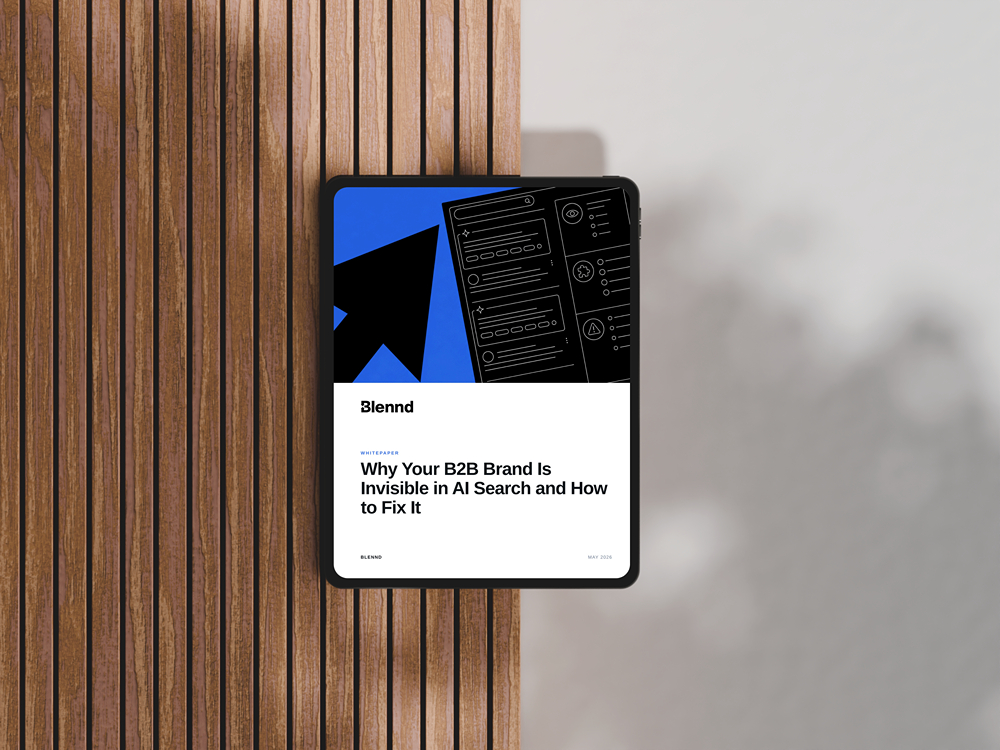
Get the Playbook
Why Your B2B Brand is Invisible in AI Search and How to Fix It
Gap 1: Positioning Clarity
What it is: A positioning clarity gap occurs when buyers cannot quickly understand what you do, who you serve, and why you are different.
How to spot it: A first-time visitor cannot accurately explain your offer after five seconds on the homepage.
First move: Rewrite the hero around a specific audience, business problem, and outcome before changing visual design.
The first gap is how fast a first-time visitor understands what you do, who you serve, and why it matters. Competitors that convert more leads answer these questions in the first five seconds. Weaker sites bury the value proposition in generic taglines, vague hero copy, or navigation-dependent storytelling.
To audit this gap, open your homepage and a competitor’s in side-by-side browser windows. Set a timer for five seconds. At the end, ask someone unfamiliar with either company to explain what each one does and who it is for. If the competitor’s site produces a clearer, more specific answer, you have a positioning gap. This is not about cleverness or brand voice; it is about information transfer speed. High-converting sites communicate core value before the visitor scrolls, and they do it with concrete nouns and verbs, not abstraction.
Common positioning gaps include: hero sections that lead with mission statements instead of customer outcomes, navigation labels that use internal jargon instead of buyer language, and homepages that assume the visitor already knows what category you operate in. When Blennd restructured the 7Factor Software site around clearer buyer pathways, form submissions increased 467%. The result reflects a broader engagement that included a stronger information hierarchy, clearer service paths separating offerings, industries, case studies, and resources, and a redesigned conversion experience that let visitors self-identify and move forward without confusion. Getting positioning right is often the prerequisite that makes every other fix work harder, which is why it belongs at the center of any website redesign, SEO, and conversion strategy.
Gap 2: Proof of Relevance
What it is: A proof-of-relevance gap occurs when your site does not quickly show buyers that you understand their specific industry, role, or situation.
How to spot it: A visitor from a target segment has to click more than once to find evidence you have solved their problem before.
First move: Bring industry-specific proof forward onto the homepage and the top of service pages, using the buyer’s language.
The second gap is how quickly your site demonstrates that you understand the visitor’s specific context. Competitors that convert more leads surface proof points early: a recognizable client logo from the visitor’s industry, a case study headline that names a familiar problem, a service description that uses the visitor’s language instead of yours.
To audit this, simulate a buyer journey. Pick a target persona (e.g., VP of Marketing at a mid-market SaaS company evaluating demand generation partners). Navigate both sites as if you are that person. Which site makes you feel understood faster? Which one requires more clicks to find evidence that the company has worked with buyers like you? Sites that underperform on this dimension tend to organize content around internal structures (our services, our process, our team) instead of external contexts (your industry, your growth stage, your problem).
The proof-of-relevance gap shows up in homepage layouts that feature generic stock photography instead of real client work, service pages that describe capabilities without naming outcomes, and case study sections that bury industry filters three levels deep. High-performing sites bring proof forward. They use homepage modules to showcase industry-specific work, they open service pages with recognizable buyer pain points, and they make filtering by vertical or use case the default experience, not a buried feature.
Gap 3: Industry and Use-Case Pages
What it is: An industry and use-case coverage gap occurs when your site lacks dedicated pages for the specific verticals and scenarios buyers search for.
How to spot it: Competitors rank for “[your service] for [industry]” queries with dedicated pages while you have only a generic services page.
First move: Build one dedicated landing page for your highest-value industry or use case, with specific outcomes and relevant proof.
The third gap is whether your site has dedicated pages for the industries, verticals, and use cases your buyers search for. Competitors that win more leads build content around the buyer’s frame of reference, not the seller’s internal org chart. If your target accounts search for “healthcare marketing agency” or “SaaS demand generation,” and your competitor has dedicated landing pages for those queries while you have one generic “services” page, you lose visibility and conversion opportunity simultaneously.
To audit this gap, list the five most common search queries your ideal prospects use when looking for solutions like yours. Open Google in an incognito window and search each term. Do your competitors have pages that rank for those queries? Do you? If competitors have industry-specific pages (e.g., /industries/healthcare/ or /solutions/saas-marketing/) and you do not, you are losing both organic discovery and on-site conversion. A visitor who lands on a page titled “Healthcare Marketing Solutions” will convert at a higher rate than one who lands on a generic “What We Do” page and has to hunt for healthcare relevance.
This gap is common among companies that grew through referrals and never built a search-driven content strategy. Your internal team knows you serve healthcare clients, but if that knowledge is not reflected in URL structure, page titles, H1 headings, and body content, search engines and site visitors cannot act on it. Closing this gap requires creating dedicated landing pages for each high-intent industry or use case, and populating them with specific outcomes, recognizable challenges, and relevant proof.
Gap 4: Case Study Credibility
What it is: A case study credibility gap occurs when your proof feels dated, vague, or anonymized compared with a competitor’s.
How to spot it: Your most recent case study is over a year old, or your results read as “improved performance” rather than specific outcomes.
First move: Publish or refresh one case study with a recent date, a named problem, and a specific, outcome-led result.
The fourth gap is whether your case studies feel current, specific, and believable. Competitors that generate more pipeline publish case studies with recent dates, named clients (when possible), specific outcome metrics, and enough detail that a skeptical buyer can imagine how the solution would apply to their situation. Weaker sites feature generic “success stories” with no dates, anonymized clients, vague results, and thin narratives.
To audit this gap, navigate to the case studies or client work section on your site and a competitor’s. Compare publication dates, outcome specificity, visual quality, and narrative depth. If the competitor’s most recent case study was published this quarter and yours is two years old, you have a credibility gap. If their case studies name the client, describe the problem in the client’s language, and quantify results with specific percentages or dollar figures, and yours use anonymous “leading software company” phrasing with qualitative outcomes like “improved performance,” you have a proof gap.
High-performing sites treat case studies as a proof engine, not a marketing afterthought. They update the library quarterly, they feature industry-specific outcomes prominently, they include real client quotes (even short ones), and they structure narratives around the buyer’s decision journey (problem, evaluation, solution, results). When KIOSK Information Systems shifted to a product-led sales motion, Blennd rebuilt their case study architecture to support comparison browsing and product-led conversion paths. Following that work, 50% of KIOSK leads were classified as sales-ready. The change helped create a clearer route from product evaluation to qualified inquiry.
Gap 5: Conversion Path Design
What it is: A conversion path gap occurs when the next step is unclear, high-friction, or mismatched to where the visitor is in their decision.
How to spot it: Every page offers the same “Contact Us” CTA regardless of buyer intent or readiness.
First move: Add an intent-matched CTA to your highest-traffic page (a low-commitment option for early-stage visitors, direct contact for late-stage).
The fifth gap is whether the path from landing page to lead capture is obvious, friction-free, and appropriate for buyer intent. Competitors that convert more leads design conversion paths around what the visitor is ready to do at each stage, not what the company wants them to do. A visitor researching solutions should see “Download the Guide” or “See Examples,” not “Request a Demo.” A visitor on a pricing page should see “Talk to Sales,” not “Subscribe to Our Newsletter.”
To audit this, map the conversion opportunities on key landing pages (homepage, service pages, case study pages, pricing page). For each CTA, ask: does this match visitor intent at this stage? Is the ask appropriate for how much the visitor knows about us? Is the form length reasonable for the value offered? Then repeat the exercise on a competitor’s site. If the competitor offers multiple conversion paths calibrated to different readiness levels (e.g., low-commitment content downloads for early-stage visitors, high-commitment consultation requests for late-stage), and you offer the same “Contact Us” CTA everywhere, you have a conversion path gap.
Common conversion path failures include: CTA copy that uses internal language instead of visitor benefits (“Learn About Our Methodology” instead of “See How It Works”), form fields that ask for information the visitor is not ready to share (company revenue and budget on a blog subscription form), and single-path designs that force every visitor into the same action regardless of where they are in the decision process. Sites that perform well offer progressive engagement, and disciplined conversion optimization matches each stage to the right ask: content downloads for awareness-stage visitors, interactive tools or assessments for consideration-stage, and direct sales contact for decision-stage.
Gap 6: Mobile Performance
What it is: A mobile performance gap occurs when your mobile experience is slower, harder to navigate, or harder to convert on than desktop.
How to spot it: Your mobile conversion rate trails desktop by a wide margin, or key pages load noticeably slower on a phone.
First move: Test your top service page and contact form on a real phone, then fix the single worst friction point you find.
The sixth gap is whether your mobile experience is as functional and conversion-friendly as your desktop experience. Competitors that win more leads treat mobile as a primary experience, not a responsive afterthought. If your site is slower on mobile, harder to navigate, or requires horizontal scrolling and pinch-zooming to interact with core content, you lose leads to competitors whose mobile sites load fast, display cleanly, and make CTAs thumb-friendly.
For B2B sites, mobile friction often appears before the form: slow service pages, unreadable comparison content, poor navigation, hidden calls to action, or case studies that are difficult to scan on a phone. A buyer researching you between meetings will form an impression long before they reach a contact form, so the earlier pages matter as much as the conversion step.
To audit this, open your site and a competitor’s on a mobile device (or use Chrome DevTools mobile emulation). Navigate to a service page, a case study, and a contact form. Measure load time, check whether CTAs are easily tappable, confirm that forms are usable without zooming, and verify that navigation is simple. If the competitor’s mobile site loads quickly and yours lags, if their CTA buttons are large enough to tap comfortably and yours require precision, if their forms auto-format phone numbers and yours do not, you have a mobile performance gap.
Google’s mobile-first indexing means the search engine now evaluates your mobile site as the primary version, so mobile performance directly impacts organic visibility. Closing this gap requires optimizing images for mobile bandwidth, simplifying navigation for smaller screens, designing touch-friendly CTAs, and testing forms on actual devices. Ongoing website optimization services keep those gains from eroding as new content and features ship.
Gap 7: SEO and AI Visibility
What it is: An SEO and AI visibility gap occurs when buyers cannot find you in search results or AI-generated answers for the queries that matter.
How to spot it: Competitors appear on page one and in AI answers for your priority terms while you do not.
First move: Pick one high-intent query, then structure a page to answer it directly with clear entity information and original proof.
The seventh gap is whether prospects searching for solutions like yours can find your site in traditional search results and AI-generated answer environments. Competitors that generate more inbound leads rank for high-intent keywords, appear in Google AI Overviews, get cited by ChatGPT and Perplexity, and show up in local pack results when geography matters. If your site is invisible in these channels and theirs is not, the lead volume difference compounds over time.
To audit this gap, identify the five most valuable search queries for your business (e.g., “B2B web design agency,” “demand generation for SaaS,” “website gap analysis”). Search each in Google, Bing, and ChatGPT. Where do you and your competitors appear? Do they rank on page one while you are on page three? Do they appear in AI Overviews while you do not? Do they show up in local results for geo-targeted queries while you do not? Each visibility gap represents lost discovery opportunity.
AI-generated answers now appear across many commercial and informational searches. Brands are more likely to be cited when their websites provide clear entity information, original proof, structured content, and direct answers to buyer questions. If competitors publish content that AI engines cite as sources and you do not, you lose both traditional organic traffic and AI-mediated discovery. Closing this gap is the core of a modern AI search visibility strategy: structured data, answer-first content architecture, and demonstrable expertise, experience, authoritativeness, and trustworthiness.
Gap 8: Local Relevance
What it is: A local relevance gap occurs when your site does not deliver location-specific content and proof for geo-based buyers.
How to spot it: You do not appear in the local pack for “[your service] in [your city],” or you lack dedicated location pages.
First move: Build one location page with unique local content, proof, and consistent name, address, and phone data.
The eighth gap is whether your site delivers location-specific content and conversion paths for buyers searching in specific geographies. Competitors that serve multiple markets build dedicated location pages with local addresses, phone numbers, case studies, team bios, and community involvement. If your business operates in Denver, Austin, and Chicago, but your site treats all three as interchangeable (or does not mention them at all), you lose local search visibility and fail to build trust with geo-conscious buyers.
To audit this, search for “[your service] in [your city]” in Google (e.g., “web design agency in Denver”). Do you appear in the local pack (the map-based results at the top of the page)? Do you have a dedicated landing page for that geography? Now repeat the search for a competitor. If they have location pages with unique content, local case studies, Google Business Profile integration, and you do not, you have a local relevance gap.
Moz’s Local Search Ranking Factors research shows that proximity, Google Business Profile signals, and on-page location signals are among the strongest ranking factors for local queries. Sites that perform well in local search create pages for each service area with unique content (not just templated “We serve [city]” pages), embed Google Maps, include local phone numbers, feature region-specific case studies, and maintain consistent NAP (name, address, phone) data across the site and third-party directories.
Gap 9: Ease of Next Steps
What it is: An ease-of-next-steps gap occurs when visitors have to hunt for what to do next on any given page.
How to spot it: Key pages have footer-only CTAs, or content pages dead-end with no logical next link.
First move: Add a visible, relevant next step to your most-visited content and case study pages.
The ninth gap is whether your site makes it obvious what a visitor should do next at every stage of the journey. Competitors that convert more leads design navigation, in-page CTAs, and content flow so that the visitor never has to guess where to click or what to do. If a visitor lands on a case study and wants to see more examples, the path to the next case study should be one click away. If they finish reading a service page and are ready to talk, the “Schedule a Call” CTA should be visible without scrolling.
To audit this, navigate through your site as a prospect would. After each page, ask: what should I do next, and is it obvious? Then repeat on a competitor’s site. If the competitor uses sticky CTAs that stay visible as you scroll, in-line “Next steps” prompts after key content sections, and related-content modules that guide you to logical next pages, and your site does not, you have an ease-of-navigation gap.
This gap shows up in sites with footer-only CTAs (requiring the visitor to scroll to the bottom of every page to take action), unclear navigation hierarchies (services buried under “Solutions” or “What We Do” with no visible submenu), and dead-end pages (blog posts, case studies, or resource pages with no related links or conversion prompts). High-converting sites treat every page as a potential entry point and every section as an opportunity to guide the visitor forward. They use persistent CTAs, related-content recommendations, and clear visual hierarchy to reduce decision friction.
Gap 10: Content Currency
What it is: A content currency gap occurs when your site looks abandoned relative to an actively maintained competitor.
How to spot it: Your latest post, case study, or copyright year signals the site has gone quiet.
First move: Refresh your most visible dated content and set a light publishing and update cadence you can sustain.
The tenth gap is whether your site feels actively managed or abandoned. Competitors that generate more leads publish fresh content regularly, update case studies and client lists, refresh blog posts with current data, and show visible signs that a human is maintaining the site. If your most recent blog post is from 2022, your case studies feature outdated logos, and your homepage hero image shows a product version you no longer sell, buyers will assume the business itself is stagnant.
To audit this, check the date stamps on blog posts, case studies, and news sections on both your site and a competitor’s. Look for signs of active maintenance: recent content updates, current copyright year in the footer, accurate team bios, up-to-date product screenshots. If the competitor published content this month and you have not published since last year, you have a currency gap. If their case studies show recent outcomes and yours reference initiatives from several years ago, you lose credibility.
Content currency does not require publishing daily. It requires consistency and relevance. A site that publishes one high-quality article per quarter and keeps case studies current will outperform a site that published 50 blog posts in one busy year and then went silent. Buyers interpret outdated content as a signal of business health, so even small updates (refreshing stats in an older post, adding a new case study, updating team photos) improve perceived credibility and conversion likelihood.
Frequently Asked Questions
Can a website gap analysis identify conversion problems without redesigning the entire site?
Yes, and often the highest-impact fixes require no visual redesign. Many conversion gaps are structural (missing industry pages, weak case study content, unclear CTAs) or technical (slow mobile load times, poor local SEO setup). A gap analysis prioritizes addressable issues by impact, so you can close critical gaps incrementally without committing to a full rebuild.
How often should a B2B company run a website gap analysis against competitors?
Quarterly is a reasonable cadence for most industries. Markets shift, competitors launch new features or content, and search algorithms evolve. A quarterly review ensures you catch new gaps before they compound into significant lead volume loss. Annual reviews are too slow; monthly reviews are overkill unless you operate in an exceptionally volatile category.
What if competitors rank higher but have objectively weaker content or case studies?
Search visibility gaps are often technical, not content-quality-related. A competitor with weaker case studies but stronger backlink profiles, faster load times, better schema markup, or more location pages may outrank you. The gap analysis should surface these technical differences so you can address root causes, not just content depth.
Should website gap analysis focus on direct competitors or best-in-class sites outside your industry?
Both. Direct competitors show you the performance bar in your specific market. Best-in-class sites outside your industry (especially those serving similar buyer types) reveal structural patterns and UX approaches that your direct competitors may not have adopted yet. Studying both gives you a clearer picture of what is possible and what is necessary.
How do you measure whether closing a gap improved lead volume?
Set a baseline conversion rate for the pages or journeys you are improving, implement the changes, and measure conversion rate over the following 60 to 90 days. Use GA4 goals, CRM attribution, or form-fill tracking to isolate the impact. If you fix a mobile performance gap, compare mobile conversion rates before and after. If you add industry pages, track organic traffic and conversions from those pages specifically.
Does fixing website gaps require agency help or can an internal team do it?
It depends on the gaps. Fixing content currency, updating case studies, and improving CTA copy are internal-team tasks if you have the bandwidth. Technical gaps (Core Web Vitals, schema markup, mobile optimization) and strategic gaps (positioning clarity, IA restructuring) often benefit from outside expertise because they require cross-functional coordination and domain knowledge most in-house teams do not maintain full-time.
Sources
- Mobile-First Indexing Best Practices. Google Search Central, 2024.
- Local Search Ranking Factors. Moz, 2024.
- Core Web Vitals and Page Experience. Google, 2024.
Ready to close the gaps costing you qualified leads?
Blennd helps B2B brands diagnose and address the structural performance gaps that let competitors win pipeline. We combine website gap analysis, conversion optimization, and strategic repositioning to build platforms that convert traffic into revenue. If your site isn’t converting at the level your market position deserves, let’s talk about what’s missing and how to fix it.