
Most companies scope their B2B website redesign as if the hardest part is choosing fonts and building pages. The brief asks for a modern look, cleaner navigation, and mobile responsiveness. The agency delivers wireframes, comps, and a component library. Launch happens. The site looks better. Six months later, the metrics that matter have barely moved, and no one can explain why.
Key Takeaways
The most expensive mistake in a B2B website redesign is not what you build, it is what you forget to define first. AI design tools can now generate pages, components, and production-ready code directly on the canvas, so page production is the part that just got cheap. If you are still paying an agency to turn a sitemap into templates, you are paying for the commoditized layer. The value has moved to two places: upstream (positioning, differentiation, information architecture, conversion strategy) and downstream (measurement infrastructure, integrations with your marketing system, performance optimization, governance). Companies that treat redesigns as design projects get beautiful sites that do not produce pipeline. Companies that treat them as revenue projects build systems that compound value over time.
Why Most B2B Website Redesigns Fail
The pattern is consistent. A company decides the website feels dated. Marketing gets budget approval. An RFP goes out asking for “a modern, mobile-first site that reflects our brand.” Agencies respond with case studies of polished work. The decision comes down to aesthetic taste and which team felt easier to work with. The project starts. Months later, the new site launches. It looks good. But leads do not increase, demo requests stay flat, and sales complains the site still does not communicate what the company does.
The problem is not the design. The problem is that the company optimized for the wrong outcome. A website redesign framed as a design project will produce a site that looks better. A website redesign framed as a revenue project will produce a site that performs better. The difference is what you define as success before anyone opens Figma.
Most companies skip the hardest questions. What conversion paths exist today, and which ones actually produce pipeline? Which pages generate qualified leads versus noise? Where do prospects drop off? What does sales need the site to communicate before they take a call? What integrations with HubSpot, Salesforce, or your marketing automation platform need to work for attribution to function? These questions are harder than “should the hero section have a video or a static image,” so they get deferred. Then the site launches and you realize the beautiful design is not connected to anything that drives revenue.
The Part That Just Got Commoditized
At Config 2026, Figma CEO Dylan Field introduced code layers, a feature that turns any design layer into an interactive, code-backed layer with a single click or prompt, and lets teams pull GitHub-linked repositories directly onto the design canvas. His framing was blunt: “Code is not the opposite of design. Code is material for design.” Framer, Webflow, and a dozen AI-native tools are converging on the same capability. These tools did not make design irrelevant. They made page production the easy part.
Five years ago, turning a sitemap into 40 unique page templates required weeks of design iteration, development work, QA, and revision cycles. That was the bottleneck. Agencies built business models around it. Today, an experienced designer working with AI tools can generate those same 40 templates in a fraction of the time, and the output is closer to production-ready. The constraint is no longer “how do we build this,” it is “what should we build, and why.”
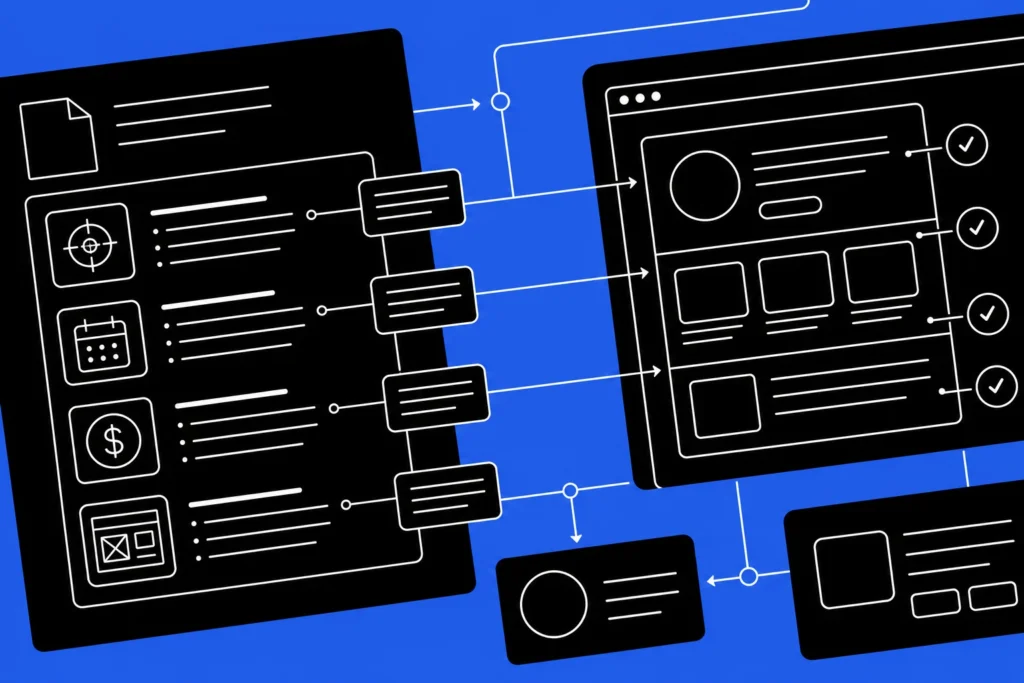
If your redesign process still treats page production as the expensive, time-intensive centerpiece, you are optimizing for the part that AI just made cheap. The value has moved. Upstream, the hard work is now positioning (what makes your offer different in a way that matters to buyers), information architecture (how you structure the site so the right people find the right content and move toward the right conversion), and conversion strategy (what action you want each audience to take, and how you design the path to make that action feel obvious). Downstream, the hard work is measurement (can you connect site activity to pipeline?), integration (does the site talk to your CRM, MAP, analytics, and attribution tools?), performance (does it load fast enough that buyers do not bounce?), and governance (can your team update content without breaking things?).
Field closed the Config keynote with the sentence that should govern every redesign budget in 2026: “AI has lowered the floor, but it has not raised the ceiling.”
What Should Be Expensive (But Usually Is Not)
The highest-value work in a B2B website redesign happens before and after the design phase. Most agencies do not charge enough for it because most clients do not know to ask for it. Here is what actually determines whether a redesign produces pipeline.
Positioning and differentiation. Most B2B websites describe what the company does in language that could apply to ten competitors. “We help companies accelerate growth through innovative solutions.” That sentence communicates nothing. Buyers visiting your site are comparing you to alternatives. If your positioning does not immediately clarify how you are different, and why that difference matters to them, they leave. The hard work is diagnosing what makes your approach genuinely distinct (not just “better”), then translating that into a message hierarchy that runs through every page. This requires research, competitive analysis, buyer interviews, and creative thinking. Most redesign projects skip it entirely. It is also the work that determines whether your brand gets surfaced and cited in AI answers, because a model cannot differentiate you from ten competitors if your own site cannot.
Information architecture for buyer intent. The decision is largely made before you meet the buyer. 6sense’s 2025 Buyer Experience Report, a global study of nearly 4,000 B2B buyers, found that buyers now make first contact with a vendor around 61% of the way through their journey, and that 95% of the time the winning vendor was already on the buying group’s day-one shortlist. Four out of five deals go to the pre-contact favorite. That means your site has to do the work that a sales conversation used to do: qualify the prospect, communicate value, handle objections, and get you onto the shortlist before anyone fills out a form.
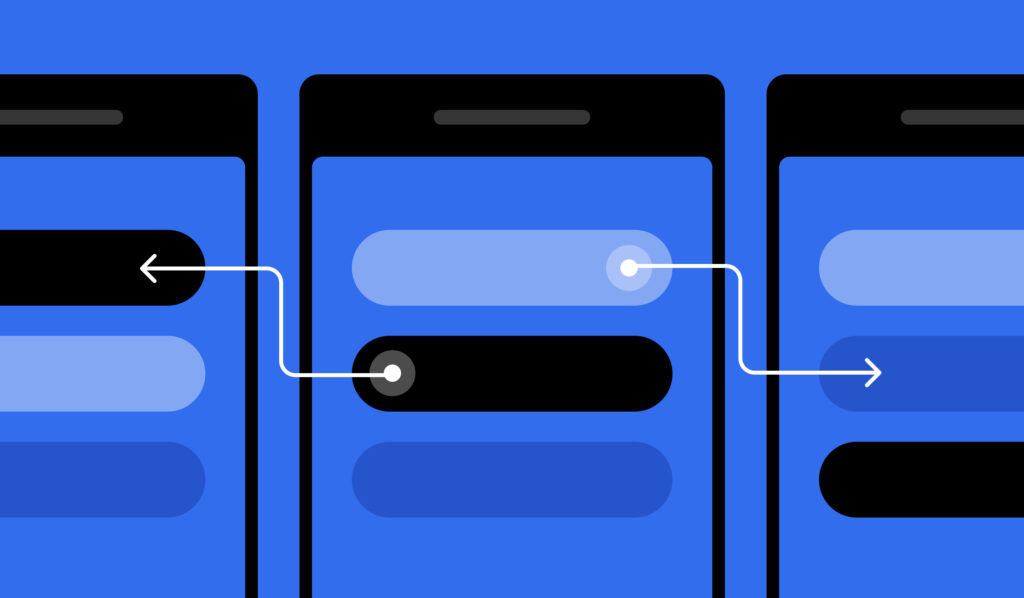
If your site is organized around your internal org chart (Products, Services, About Us, Contact), it is not organized around buyer intent. The right IA starts with understanding what questions prospects ask at each stage of evaluation, then building content paths and conversion opportunities that match those questions. For a SaaS company, that might mean separate journeys for “implementing for the first time,” “replacing an existing tool,” and “expanding usage across teams.” For a consulting firm, it might mean self-identification by industry, problem type, or buying stage. This work is strategic, not tactical, and it has more impact on conversion than visual design.
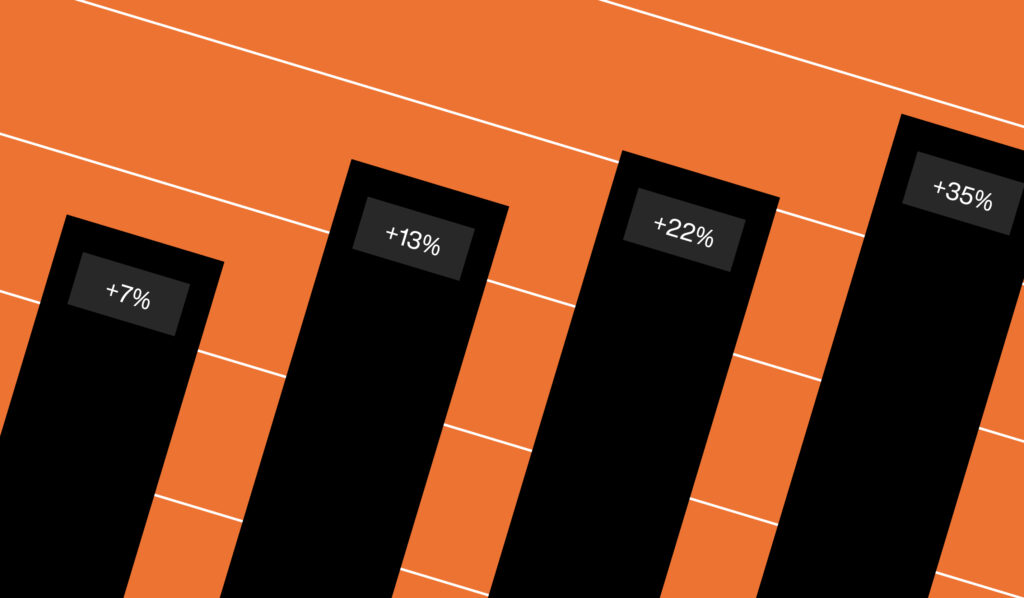
When 7Factor Software rebuilt their site to position as a strategic consulting partner rather than an order-taking development vendor, Blennd restructured the entire experience around buyer evaluation patterns, separating core offerings, case studies, and resources so prospects could self-navigate based on their decision stage. The result was a 467% increase in form submissions and a 102% increase in Google Search Console clicks.
Conversion path design. Most sites treat conversion as an afterthought. There is a contact form in the footer. Maybe a demo request button in the nav. The rest of the site is informational. That is not a conversion strategy, it is a placeholder. A real conversion strategy maps every audience, every stage of awareness, and every page type to a specific next action. It uses progressive disclosure (do not ask for a phone number when an email will do). It aligns the ask with the value delivered (a one-field newsletter signup if the content was top-of-funnel, a multi-field demo request if the content answered late-stage objections). It tests CTA placement, phrasing, and design against actual behavior, not best practices. This requires conversion rate optimization expertise, analytics instrumentation, and a willingness to iterate post-launch. Most redesigns treat the site as done once it goes live.
When KIOSK Information Systems shifted from custom projects to a product-led sales motion, Blennd rebuilt the site around an eCommerce-like product comparison experience and reorganized navigation to support self-service evaluation. The result was that 50% of leads became sales-qualified, and the company hit 157% of its SQL goal for the year.
Get the Playbook
Why Your B2B Brand is Invisible in AI Search and How to Fix It
The Downstream Work That Determines Long-Term ROI
A polished site that launches without the right infrastructure underneath it is a liability, not an asset. The things that make a website a revenue engine happen in the layer most clients never see.
Measurement and attribution. If you cannot connect site activity to pipeline, you cannot optimize. That means conversion tracking, event tracking, CRM integration, UTM hygiene, multi-touch attribution, and dashboard infrastructure that lets marketing prove ROI. This is not “nice to have.” It is the difference between a site you can improve and a site you are guessing about. Most redesigns launch with Google Analytics installed and call it done. That is not measurement, it is data collection. Real measurement means defining what actions matter (demo requests, gated content downloads, pricing page visits, repeat engagement), tracking those actions across sessions and devices, connecting them to closed deals, and building reports that let you see what is working. If your agency is not scoping this work, your redesign will not deliver compounding returns.
There is a new wrinkle worth instrumenting now. AI-referred traffic (visitors arriving from ChatGPT, Perplexity, Gemini, Claude, and Copilot) is still small in volume, roughly 1% of total site traffic on average, ranging from about 0.1% to 2.8% depending on industry. But it is growing fast, it skews toward high-intent research behavior, and most GA4 setups classify it as generic referral or direct traffic by default. If you do not configure a channel group for it during the redesign, you will have no baseline when the channel matters.
Integration with your marketing system. A B2B website does not exist in isolation. It is one node in a larger system: your CRM (Salesforce, HubSpot), your marketing automation platform (Marketo, Pardot, HubSpot), your advertising platforms (Google, LinkedIn), your analytics stack (GA4, Looker, Tableau), and any lead enrichment or intent tools you use. If those integrations are not planned and tested before launch, your data will be messy, your attribution will be broken, and your team will spend months troubleshooting instead of optimizing. Integration work is boring, technical, and expensive. It is also the only way your redesign becomes part of a demand generation engine instead of a static brochure.
Performance and accessibility. Core Web Vitals affect both conversion rates and search rankings. A slow site loses buyers before they see your positioning. An inaccessible site excludes prospects and exposes you to compliance risk. Performance is not a design problem, it is an engineering problem, and it requires ongoing optimization (image compression, lazy loading, caching, CDN configuration, code splitting). Most agencies deliver a site that performs well on launch day, then performance degrades as the marketing team adds scripts, plugins, and third-party tools. A sustainable site requires governance: rules about what can be added, monitoring to catch performance regressions, and an ongoing website maintenance plan to keep the site fast as it evolves.
How to Scope a Redesign for Revenue, Not Appearance
If you are holding a B2B website redesign budget, here is how to aim it at the right problem.
Start with business outcomes, not creative briefs. Before you talk to agencies, define what success looks like in measurable terms. Not “a modern site that reflects our brand.” Specifics: increase demo requests by 30%, reduce cost per lead by 20%, improve lead quality so sales accepts 50% instead of 30%, cut time-to-close by eliminating FAQ calls. If you cannot define what the site needs to do for the business, you cannot evaluate whether the redesign worked.
Audit what you have before you replace it. Most companies rebuild their site without understanding what is working today. Which pages drive conversions? Which content ranks? Where does traffic come from? What user paths lead to pipeline? An audit is not a nice-to-have, it is the baseline. If you skip it, you will rebuild the parts that work and keep the parts that do not. This is also where redesigns most often destroy value: a rebuild that changes URLs without a redirect map can erase years of accumulated organic search equity in a single deploy.
Evaluate agencies on strategy, not portfolio. A portfolio tells you the agency can design. It does not tell you whether they can solve your problem. Ask how they approach positioning. Ask what frameworks they use for information architecture. Ask how they structure conversion paths. Ask what analytics and attribution infrastructure they implement. Ask how they handle performance and governance post-launch. If the answers are vague or focus only on the design phase, keep looking. (We wrote a full guide on how to write a web design RFP that surfaces these answers before you sign anything.)
Plan for iteration, not perfection. No site is perfect at launch. The best sites improve continuously because the team treats launch as the beginning of optimization, not the end of the project. Budget for post-launch testing, analytics review, CRO experiments, and content iteration. A site that launches at 80% and improves every quarter will outperform a site that launches at 95% and never changes.
If you are early in the process and still deciding what kind of partner you need, our web design and development services page breaks down where strategy, design, and engineering each sit in a modern build.
The AI Shift Makes This Urgent
AI has not made websites less important. It has made bad websites more expensive. When design tools can generate pages in minutes, the differentiator is no longer execution speed, it is strategic clarity. The companies that win are the ones that know what to build and why, then use AI to build it faster. The companies that lose are the ones still paying agencies to do work that AI now does better, while under-investing in the work AI cannot do: positioning, strategy, conversion architecture, and systems thinking.
There is a second-order effect worth naming. As buyers increasingly start their research inside AI assistants, the sites that get cited in those answers are the ones that state a clear, specific, extractable position. A site full of hedged, generic capability copy gives a language model nothing to quote. A site that says exactly who it is for and how it is different gives the model a sentence it can attribute to you. Positioning is no longer just a conversion lever. It is a distribution lever.
The opportunity is to redirect spend. Less on templates, more on strategy. Less on revisions, more on measurement. Less on the site as artifact, more on the site as system. That is what separates redesigns that look good from redesigns that produce pipeline.
Frequently Asked Questions
Does a B2B website redesign always require repositioning work?
Not always, but often. If your existing positioning is sharp, differentiated, and validated by buyer feedback, you can keep it. But most companies discover during a redesign that their messaging is generic or misaligned with how buyers actually evaluate them. Repositioning work is expensive and time-intensive, but it is almost always the highest-ROI part of a redesign because it affects every page and every conversion path. If you are rebuilding the site anyway, it is the right time to get positioning right.
How do I know if my website redesign should prioritize conversion rate optimization or SEO?
Both matter, but the priority depends on where your traffic comes from today. If you already have strong organic traffic but low conversion, CRO is the bigger lever. If you have high conversion but low traffic, SEO is the constraint. Most B2B sites need both, which is why redesigns should be scoped with integrated SEO and CRO strategy from the start, not bolted on later. A site architecture that is good for conversion is usually good for SEO: clear user intent, fast performance, semantic HTML, and logical internal linking.
What is the typical cost of a B2B website redesign focused on revenue outcomes?
Cost varies widely based on scope, but a strategic redesign (positioning, information architecture, conversion architecture, design, development, integrations, measurement infrastructure) typically ranges higher than a cosmetic refresh. The determining factors are complexity (number of audience segments, product lines, integrations), custom development needs (CRM sync, calculators, gated content systems), and whether the project includes ongoing optimization post-launch. The ROI comes from treating the site as a revenue system, not a one-time deliverable.
Can I use AI design tools to handle my redesign in-house?
You can use AI tools to accelerate production, but strategy, positioning, and conversion architecture still require expertise. AI tools are good at generating variations, building components, and writing code. They are not good at diagnosing why your site does not convert, mapping buyer journeys, or integrating your site with your CRM and attribution stack. The risk of a fully in-house redesign is that you rebuild the site faster, but without fixing the underlying problems that caused the old site to underperform.
How long does a revenue-focused B2B website redesign take?
A strategic redesign typically takes three to six months from discovery to launch, depending on scope. Discovery and positioning work (one to two months) happens before design starts. Design and development (two to three months) happen in parallel where possible. Post-launch optimization is ongoing. Rushed redesigns skip the upfront strategy work, which is why they often look good but do not move metrics. If an agency promises a full redesign in six weeks, they are skipping something important.
How do I measure whether my B2B website redesign succeeded?
Define success metrics before the project starts, then track them for at least six months post-launch. Typical metrics include conversion rate by page and audience, cost per lead, lead quality (sales accept rate), organic traffic and rankings, engagement (time on page, scroll depth, pages per session), and pipeline contribution. A site that launches with a 20% conversion lift but no attribution infrastructure in place is a missed opportunity, because you cannot prove ROI or optimize further.
Sources
- Config 2026: New Materials, New Tools and a More Expressive Canvas. Dylan Field, Figma, June 2026.
- The B2B Buyer Experience Report 2025. 6sense, 2025. (Global study of nearly 4,000 B2B buyers.)
- AI Traffic Is Around 1% of the Web. Analyze, 2026. (Aggregating Conductor, Chartbeat, and Adobe data.)
- Core Web Vitals. Google.
Ready to scope your redesign around revenue, not templates?
Most agencies still sell websites by the page. We start with the business outcomes you need to hit, then work backward to the positioning, information architecture, and conversion paths that can actually deliver them. If you are holding a redesign budget and want to make sure it is aimed at the right problem, let’s talk.